
False.
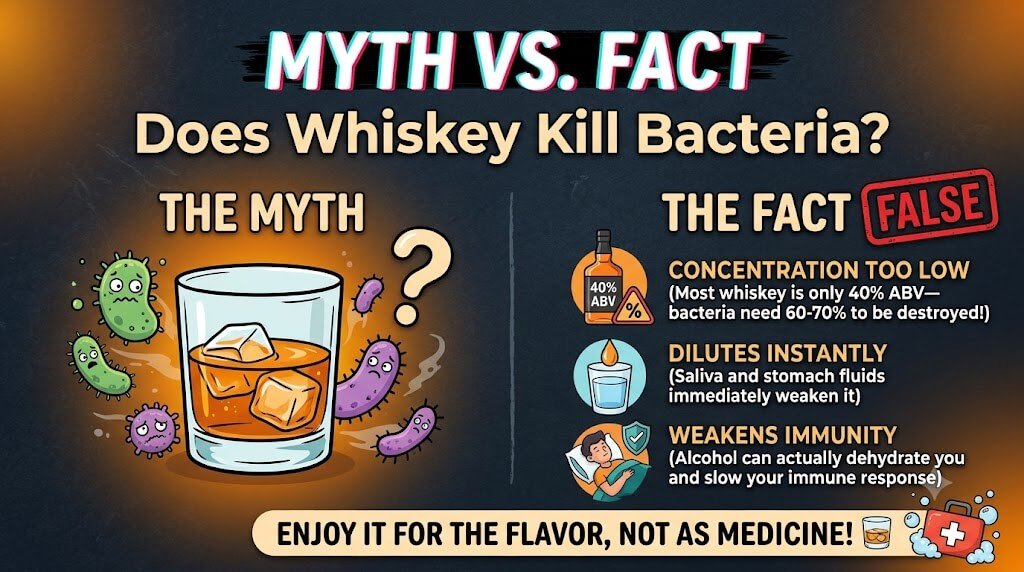
Whiskey does not kill bacteria in your body.
- Concentration is too low: Most whiskey is roughly 40% alcohol (80 proof), but destroying bacteria requires at least 60% to 70% alcohol.
- Instant dilution: Once swallowed, saliva and stomach fluids immediately dilute it far below any germ-killing level.
- Immune strain: Excessive alcohol can dehydrate you and temporarily weaken your immune system rather than help fight off an infection.
The Biological Reality of Whiskey and Bacterial Survival
For generations, folk medicine has championed strong spirits as an impromptu shield against illness. From the traditional “hot toddy” prescribed for winter colds to the belief that a stiff drink can neutralize contaminated food or water, alcohol frequently masquerades as a therapeutic cure-all. Among distilled beverages, whiskey carries a particularly potent reputation for its warmth, bite, and historical use in early medicine.
However, modern microbiology and human physiology paint a very different picture. The idea that drinking whiskey actively kills harmful bacteria inside the human body is primarily false. While ethanol does possess potent antimicrobial mechanisms, the concentration, environment, and biological processing of whiskey prevent it from functioning as an internal disinfectant.
How Alcohol Eradicates Pathogens: The Chemistry of Disinfection
To understand why whiskey falls short, it is essential to examine how alcohol destroys microbial life under optimal laboratory conditions.
Alcohol exerts its germicidal effect primarily through two mechanisms: protein denaturation and membrane disruption. Ethanol molecules penetrate the cellular membrane of bacteria, dissolving the lipid bilayer and causing essential cellular proteins to unfold and coagulate. Once these structural and functional proteins lose their shape, the bacterium loses its integrity, leaks intracellular contents, and dies.
Crucially, this mechanism requires very specific conditions:
- Optimal Concentration: Disinfectants universally require an alcohol concentration between 60% and 90% by volume. Water plays a vital role in the denaturation process; pure 100% alcohol causes outer cellular proteins to coagulate too rapidly, forming a protective barrier that shields the inner organism. Dilutions below 60% lose their potency exponentially.
- Sufficient Contact Time: Germicidal action is not instantaneous. Medical-grade sanitizers typically require at least 30 to 60 seconds of uninterrupted direct contact with the pathogen to neutralize vegetative bacterial cells.
Why Whiskey Fails as an In Vivo Antimicrobial Agent
Whiskey differs fundamentally from hospital-grade disinfectants across several chemical and physiological parameters.
1. Inadequate Alcohol Concentration
The vast majority of commercially available whiskeys—whether Scotch, Bourbon, Rye, or Irish—are bottled between 40% and 45% alcohol by volume (ABV), translating to 80 to 90 proof. Even higher-strength cask-strength whiskeys rarely exceed 55% to 60% ABV.
At 40% ABV, ethanol exhibits significantly diminished bactericidal activity. While it may inhibit bacterial proliferation in a sterile dish over an extended period, it does not reliably or rapidly kill hardy pathogenic bacteria such as Staphylococcus aureus, Escherichia coli, or Salmonella enterica.
2. Immediate Physiological Dilution
Even if a spirit were bottled at 60% ABV, it encounters immediate dilution the moment it enters the oral cavity.
Salivary glands immediately introduce fluid, lowering the effective alcohol percentage. As the liquid progresses down the esophagus and reaches the stomach, gastric juices, mucus, and existing food contents dilute the spirit further into single-digit percentages. At these low levels, any acute antimicrobial capacity vanishes entirely.
3. Rapid Gastric Transit and Contact Time
To kill bacteria, alcohol must remain in physical contact with the targeted cell. Swallowing whiskey moves the liquid across the mucosal surfaces of the mouth and pharynx in a fraction of a second. This brief exposure is insufficient to penetrate microbial cell walls, leaving surface pathogens largely undisturbed while irritating the mucosal lining.
In Vitro Observations: Whiskey in the Glass vs. Inside the Body
Laboratory experiments have shown that chilling whiskey with ice cubes contaminated with bacteria (such as Salmonella, Listeria, or Pseudomonas) does lead to an eventual reduction in bacterial counts over hours. The combination of alcohol, acidity, and freezing temperatures creates an inhospitable medium for certain vegetative cells over extended durations.
However, an in vitro test tube model cannot be equated to in vivo biological defense. Inside a human host, bacteria are frequently embedded in mucosal biofilms, deep within crypts of the tonsils, or protected by digestive matter. Furthermore, the human body actively absorbs and metabolizes ethanol via the liver and stomach lining (via alcohol dehydrogenase), reducing its systemic presence to trace blood alcohol levels (e.g., 0.08%), which are entirely harmless to microbes.
The Counterproductive Impact on the Immune System
Attempting to treat a bacterial infection with whiskey is not merely ineffective; it can actively impair the body’s natural defenses.
- Mucosal Dehydration and Barrier Disruption: High-proof ethanol acts as a mild irritant to the mucous membranes of the respiratory and digestive tracts. Rather than clearing an infection, it can strip away the protective mucus layer and cause micro-abrasions, providing pathogens an easier pathway to invade tissue.
- Suppression of Leukocyte Function: Research consistently demonstrates that acute alcohol consumption hinders the response of key immune cells, including neutrophils, macrophages, and T-cells. It dampens the production of inflammatory cytokines needed to recruit white blood cells to the site of infection.
- Dehydration: Alcohol inhibits the secretion of vasopressin (anti-diuretic hormone), triggering increased fluid excretion. Proper hydration is critical for lymphatic circulation, mucus production, and cellular repair during an infection.
Conclusion
The belief that whiskey kills bacteria remains an enduring myth rooted in historical necessity and the undeniable power of industrial alcohol as an antiseptic.
While ethanol is a recognized antimicrobial agent in topical applications and surface sanitization, whiskey lacks the concentration, contact time, and chemical persistence required to eliminate bacterial pathogens inside the human body. Medical infections—whether respiratory, gastrointestinal, or systemic—demand targeted clinical therapies such as appropriate hydration, supportive care, and prescription antimicrobials, leaving whiskey to be appreciated purely as a beverage rather than a remedy.
Frequently Asked Questions (FAQ)
Can drinking whiskey kill bacteria in the stomach or throat?
No. Standard whiskey contains around 40% alcohol by volume (ABV), which is too low to effectively disinfect tissue. Additionally, saliva and stomach acids dilute the alcohol immediately upon ingestion, neutralizing any potential antimicrobial effect before it can destroy pathogens.
What concentration of alcohol is required to kill bacteria?
To reliably eliminate bacteria and viruses, alcohol solutions generally require a concentration between 60% and 90% by volume, along with direct contact for at least 30 to 60 seconds. Most commercial whiskeys fall far below this threshold at 40% to 45% ABV.
Does adding whiskey to ice or water sanitize it?
While high-proof alcohol can suppress certain bacterial strains over several hours in a glass, it does not reliably or rapidly sterilize contaminated water or ice. Relying on spirits to sanitize unsafe drinking water carries significant health risks.
Why does a “hot toddy” or whiskey make a cold feel better?
Whiskey can produce a temporary sensation of warmth and mildly numb a sore throat due to local vasodilation and alcohol’s mild anesthetic effect. However, it does not treat the underlying viral or bacterial cause and can worsen dehydration if consumed in excess.
Can drinking alcohol during an infection worsen your illness?
Yes. Alcohol consumption can impair immune cell function, disrupt the mucosal lining of the throat and stomach, and cause dehydration, making it harder for the body to fight off an active infection.