
The Architecture of Reality: How Nested Systems Shape Existence
When we gaze into the night sky, the universe appears overwhelmingly vast, cold, and detached from daily life. Conversely, peering through a microscope reveals an alien landscape of pulsating organelles and molecular chains. At first glance, the cosmos and the microscopic realm seem governed by entirely different imperatives.
Yet, nature operates under a singular architectural logic: hierarchical modularity.
Reality is structured like an infinite set of nested systems. Every macroscopic entity is an assembly of smaller structures, and every small structure serves as a functional building block for a higher order. Spanning roughly forty orders of magnitude—from the observable edge of the universe down to the Planck scale—this continuous nesting links the cosmic and the subatomic without a single fundamental seam.
The Great Descent: Tracing the Scales of Being
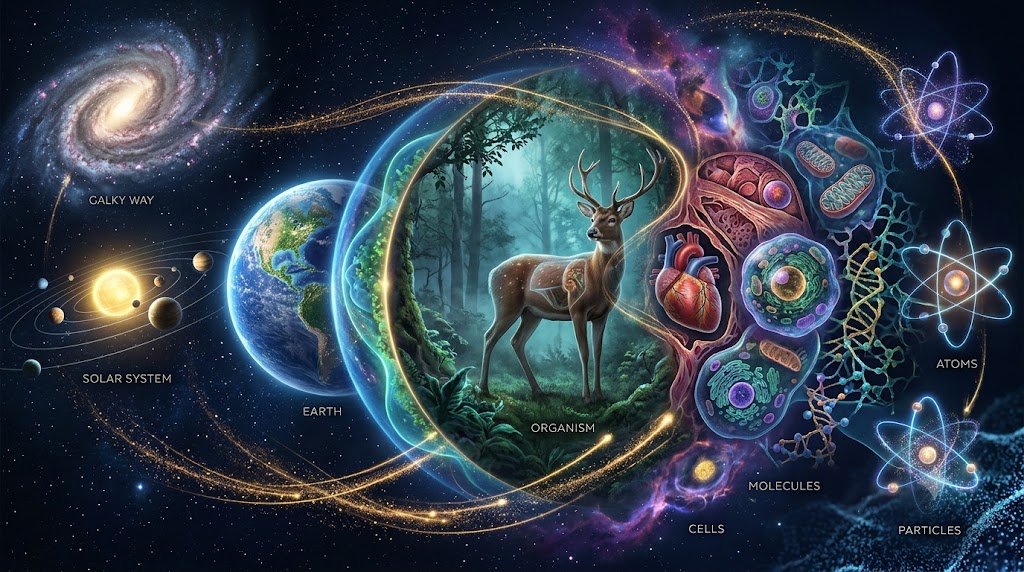
To grasp the cohesion of this hierarchy, consider a familiar, living scene: a solitary deer standing at the edge of a temperate forest. Traced downward, this singular organism anchors a seamless chain of organizational levels:
Galaxy (Milky Way)
 └── Planetary System (Solar System)
      └── Biosphere (Earth)
           └── Ecosystem (Temperate Forest)
                └── Community (Forest Flora & Fauna)
                     └── Population (Herd of Deer)
                          └── Organism (The Deer)
                               └── Organ System (Circulatory / Nervous)
                                    └── Organ (The Heart)
                                         └── Tissue (Cardiac Muscle)
                                              └── Cell (Cardiomyocyte)
                                                   └── Organelle (Mitochondria)
                                                        └── Macromolecule (Myosin / DNA)
                                                             └── Molecule (Water / ATP)
                                                                  └── Atom (Carbon / Nitrogen)
                                                                       └── Subatomic Particle (Quarks / Leptons)
1. The Astronomical Foundation
At the grandest scale, the Milky Way—a barred spiral spanning over 100,000 light-years—gravitationally binds hundreds of billions of stars. Deep within one of its outer spiral spurs lies the Solar System, organized by the gravitational dominance of the Sun. Bound to this star is Earth, a terrestrial vessel maintaining the precise physical parameters required to host complex chemistry.
2. The Ecological Scaffold
Earth’s planetary crust, oceans, and lower atmosphere form the biosphere. Within this thin film of living matter, energy flows into local ecosystems—dynamic webs where climate, topography, and living organisms interact. The forest is not a passive backdrop; it is a living community of interlinked species where a herd—a population of deer—finds shelter and sustenance.
3. The Biological Engine
The individual deer represents an autonomous, self-regulating organism. Its survival depends on coordinated organ systems—the nervous system conducting electrical impulses, the respiratory system capturing oxygen, and the circulatory system distributing vital fluids.
Take the heart: it is an organ crafted from specialized tissues like cardiac muscle, built to endure rhythmic contractions over years without mechanical failure.
4. The Microscopic Machinery
Within cardiac tissue are billions of individual cells, the foundational units of biological life. Inside each cell operates a microscopic metropolis of organelles:
- Mitochondria generate adenosine triphosphate (ATP), translating cellular nutrition into chemical fuel.
- The Nucleus archives the DNA blueprints that dictate protein synthesis.
- Ribosomes assemble amino acids into structural and functional macromolecules.
5. The Chemical and Quantum Floor
Push past the boundaries of the organelle, and biology surrenders to chemistry. Macromolecules dissolve into simpler molecules like glucose, water, and lipids. These molecules are held together by the electromagnetic bonds between atoms—predominantly carbon, hydrogen, oxygen, nitrogen, and phosphorus.
Finally, physics claims the foundation. An atom consists of electrons orbiting a dense nucleus of protons and neutrons, which themselves resolve into fundamental quarks and gluons. Beyond this threshold lie the quantum fields that constitute the very fabric of spacetime.
Emergence: The Magic of the Hierarchy
The most profound implication of nested reality is emergence: the phenomenon where a higher level of organization displays properties that none of its individual components possess on their own.
| Structural Level | Primary Components | Emergent Property |
| Water Molecule | Hydrogen & Oxygen gases | Liquid state, surface tension, universal solvency |
| Living Cell | Lipids, proteins, nucleic acids | Metabolism, self-repair, reproduction |
| Neural Tissue | Neurons & Glial cells | Coordinated electrical signaling |
| Brain / Organism | Billions of interconnected neurons | Consciousness, perception, agency |
| Ecosystem | Diverse populations & physical terrain | Dynamic homeostasis, nutrient recycling |
A single carbon atom is not alive. A strand of DNA cannot breathe, hunt, or perceive threat. A drop of blood has no concept of instinct. Yet, when stacked according to the universal syntax of nested organization, non-living particles synthesize into an animal capable of navigating a misty dawn.
Emergence ensures that complexity does not require chaotic design. Instead, the universe repeatedly applies simple rules of composition to generate boundless variety.
Why the Universe Nests: Stability and Evolution
Why does reality organize itself in hierarchies rather than as an undifferentiated mass of particles or a single monolithic structure?
Structural Resilience
Herbert Simon, the Nobel laureate cognitive scientist, illustrated this principle through the parable of two watchmakers, Hora and Tempus.
- Tempus assembled his watches from 1,000 individual parts in a single, uninterrupted sequence. If interrupted, the entire assembly collapsed, forcing him to start over from scratch.
- Hora designed his watches around stable sub-assemblies of ten parts each. Ten sub-assemblies formed a module, and ten modules formed the complete watch. When interrupted, Hora lost only a fraction of his work.
Nested hierarchies provide the universe with structural fault tolerance. If an organism dies, its molecules do not disintegrate into fundamental quarks; they break down into nutrients that fuel the soil and feed new plant life. If an individual tree falls, the forest ecosystem remains intact. Hierarchies compartmentalize risk while preserving evolutionary progress.
Efficient Energy and Information Flow
Nested networks minimize metabolic overhead. In a living animal, the fractal branching of the vascular system—from the aorta down to microscopic capillaries—optimizes fluid dynamics, delivering nutrients to trillions of cells with minimal energetic resistance. Similarly, ecological food webs distribute solar energy captured by plants through ascending trophic levels without central control.
The Cohesion of the Whole
Human thought tends to categorize the world in silos: physics studies the fundamental, biology studies the living, and astronomy studies the colossal.
In nature, these boundaries do not exist.
The heavy elements circulating within the hemoglobin of a deer’s bloodstream were forged inside the core of a dying star billions of years ago. The sunlight warming the animal’s coat is generated by subatomic nuclear fusion 150 million kilometers away, processed by chloroplasts in the leaves it eats, and converted into the motion of its limbs through cellular respiration.
The universe does not construct reality through isolated fragments. It is a single, continuous tapestry folded into layers of increasing depth and expression. From the vast rotation of galactic clusters to the silent vibration of an electron, every scale is present within, dependent upon, and essential to the next.
Frequently Asked Questions
What does it mean that reality is organized in “nested layers”?
Nested organization, or hierarchical modularity, means that complex systems are assembled from stable, lower-level components. For example, subatomic particles form atoms, atoms build molecules, molecules form cells, cells construct organs, and organisms interact within ecosystems and planetary systems. Each layer depends entirely on the stability of the level beneath it while functioning as a single unit in the level above.
What is emergence in complex systems?
Emergence is the phenomenon where a higher level of organization develops properties or behaviors that its individual parts do not possess on their own. For instance, hydrogen and oxygen are both gases at room temperature, but bonded together as water molecules, they exhibit liquid properties and surface tension. Similarly, individual neurons cannot experience awareness, yet their collective network gives rise to consciousness.
Why does the universe favor hierarchical structures instead of uniform arrangements?
Hierarchical systems offer fault tolerance and stability. In modular designs, a disturbance at one level does not cause the entire system to collapse. If an individual organism dies, the ecosystem persists, and the underlying chemical compounds cycle back into the soil rather than breaking down into subatomic particles. Hierarchies also minimize metabolic overhead, optimizing energy distribution through branching patterns like vascular systems and ecological food webs.
What is the scale difference between the cosmic and subatomic levels discussed?
The continuous chain of structure spans roughly 40 orders of magnitude. This ranges from the cosmic scale of the observable universe and galactic superclusters (measuring around $10^{26}$ meters) down to subatomic particles such as quarks and electrons (measuring around $10^{-18}$ meters or smaller).
How does the deer analogy connect biology to astrophysics?
The deer illustrates the unbroken chain of material organization. The heavy elements in its blood, such as iron, were synthesized through stellar nucleosynthesis in ancient stars. The energy powering its movement originates from nuclear fusion in the Sun, captured by plants through photosynthesis, and metabolized through cellular respiration in the deer’s tissues.