
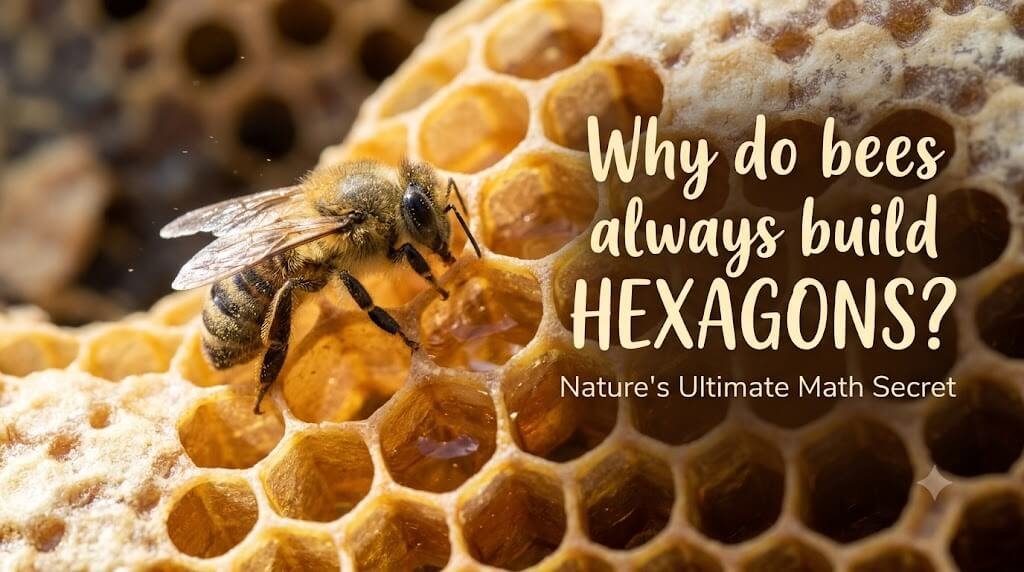
Why do bees build hexagonal cells?
Bees build hexagonal cells because the regular hexagon is the most mathematically efficient shape for tiling a flat plane. It provides the maximum storage volume using the minimum boundary perimeter and wax. Since bees consume 6–8 grams of honey to make just 1 gram of wax, hexagonal cells minimize the energy needed for hive construction while maximizing structural strength.
The Geometric Genius of the Honeycomb
For thousands of years, naturalists, philosophers, and mathematicians have gazed into the interior of a beehive with admiration. Inside these bustling colonies sits one of the most structurally refined architectures in the natural world: the honeycomb. Composed of double-sided arrays of prismatic cells, every comb conforms to a strict geometric order characterized by repeating regular hexagons.
While this pattern seems decorative at first glance, it represents a remarkable convergence of evolutionary biology, physics, and geometry. The hexagonal arrangement is not an arbitrary artistic choice by honeybees; it is a mathematically optimal solution to resource scarcity, mechanical load distribution, and spatial efficiency.
The Biological Cost of Wax
To understand why bees favor hexagonal geometry, one must examine the physiological cost of their building material. Worker bees produce beeswax through eight specialized abdominal glands. These glands secrete thin wax scales that bees chew, soften with salivary enzymes, and sculpt into comb walls.
Beeswax is chemically expensive. Producing a single gram of wax requires worker bees to consume between six and eight grams of honey. Honey is the colony’s primary energy reserve, acquired through hundreds of flight hours and thousands of floral visits. Consequently, every fraction of a millimeter of comb wall represents an investment of vital energy.
If a colony were to waste wax on an inefficient structure, it would deplete winter stores faster and jeopardize the survival of future generations. Natural selection has applied relentless pressure on honeybees to discover a framework that maximizes storage capacity while using the absolute minimum mass of wax.
The Mathematics of Planar Tessellation
From a geometric standpoint, the challenge of building a storage grid begins with planar tessellation—the process of tiling a flat surface using repeating shapes without leaving gaps or overlapping.
A circular cell, mimicking the cylindrical shape of an insect body, might seem like the most natural form to build. However, when identical circles are packed tightly together, empty voids inevitably remain between their contact points. In a circular grid, these interstitial gaps waste roughly ten percent of the total available surface area, requiring extra wax to seal off unusable pockets.
To cover a plane seamlessly, a shape must possess interior angles that divide evenly into 360 degrees. Only three regular polygons satisfy this condition:
- Equilateral Triangles (interior angles of 60 degrees; six meet at each vertex)
- Squares (interior angles of 90 degrees; four meet at each vertex)
- Regular Hexagons (interior angles of 120 degrees; three meet at each vertex)
While all three shapes pack together without leaving unused space, they differ substantially in their perimeter-to-area ratios.
The Isoperimetric Advantage and the Honeycomb Theorem
The core mathematical principle governing the honeycomb is the isoperimetric problem: among geometric figures of equal area, which has the smallest perimeter?
Consider three regular polygons, each enclosing an identical unit of internal area:
- An equilateral triangle requires a perimeter of roughly 4.56 units.
- A square requires a perimeter of 4.00 units.
- A regular hexagon requires a perimeter of approximately 3.72 units.
Because wax consumption is directly proportional to cell perimeter and wall thickness, the regular hexagon produces the greatest volume with the lowest perimeter. For an inradius $r$, the cross-sectional area equals $2\sqrt{3}r^2$, while the perimeter measures $4\sqrt{3}r$. Compared to an equilateral triangle, a hexagonal cell saves more than 18 percent of wall perimeter for the exact same storage volume. Compared to a square, it saves over 7 percent.
In 36 BC, the Roman scholar Marcus Terentius Varro first documented this insight in his agricultural treatise De Re Rustica, proposing what became known as the Honeycomb Conjecture. For over two millennia, mathematicians accepted this intuition, yet a rigorous mathematical proof remained elusive.
The conjecture was finally proven in 1999 by American mathematician Thomas C. Hales. Hales established that among all possible partitions of a two-dimensional plane into regions of equal area—regardless of whether the boundaries are straight, curved, regular, or irregular—the regular hexagonal honeycomb tiling requires the absolute minimum total boundary length. Nature had implemented this mathematical reality millions of years before humans developed the calculus to prove it.
Physics and the Construction Process
A persistent debate among entomologists is whether bees actively measure and construct hexagonal corners or whether fundamental physical forces guide the final shape.
High-resolution thermal imaging and micro-computed tomography reveal that honeybees initially deposit wax in rounded, cylindrical tubes. Worker bees cluster together during comb building, generating metabolic heat that elevates local hive temperatures to approximately 35–45 degrees Celsius. At this temperature, beeswax reaches a semi-solid, plastic state.
Under the influence of surface tension, molten and semi-plastic liquids naturally pull into configurations of least surface energy. When adjacent flexible cylinders expand against one another at equal pressure, their shared contact interfaces flatten. Where three walls intersect, surface tension pulls them into angles of precisely 120 degrees—the Plateau equilibrium observed in soap bubbles.
Thus, comb construction represents an active partnership between instinctual insect behavior and thermodynamic equilibrium. Bees intentionally deposit wax at regular spatial intervals, warm the medium to the precise softening point, and allow surface tension and mechanical pressure to complete the transition from round cylinders to sharp hexagonal prisms.
Structural Engineering and Load Distribution
Beyond surface area and wax conservation, the hexagonal grid provides immense structural integrity. Honeycomb cells must support immense weight: a mature wild comb can hold up to thirty times its own structural weight in honey, pollen, and developing brood.
In a hexagonal lattice, external loads disperse symmetrically across three 120-degree junctions rather than perpendicular 90-degree corners. This tri-directional symmetry distributes compression and shear forces evenly throughout the entire comb matrix, virtually eliminating stress concentrations that cause fractures.
Furthermore, bees tilt their cells upward by 9 to 14 degrees relative to the horizontal plane. This subtle angle prevents uncapped honey from flowing out due to gravity before it fully cures and receives a wax seal.
Hexagonal Efficiency in Modern Technology
Human engineering frequently looks to the honeycomb when designing structures that require high rigidity paired with low mass. The field of biomimicry has adapted this architecture across a broad spectrum of advanced industries:
- Aerospace and Automotive Design: Honeycomb sandwich cores made of aluminum, Nomex, or carbon composites form the bulkheads, floor panels, and wing assemblies of modern aircraft and high-speed trains. They absorb impact energy and deliver an unmatched strength-to-weight ratio.
- Optics and Telescopes: Primary mirrors for deep-space observatories—most notably the James Webb Space Telescope—are fabricated from hexagonal beryllium segments. This allows separate optical segments to tile seamlessly into a massive circular aperture with zero dead zones.
- Computer Science and Graphics: Spatial mapping systems, digital games, and telecommunications towers routinely use hexagonal tiling rather than rectangular grids. In a hexagonal grid, every adjacent neighbor is equidistant from the center cell, eliminating the diagonal distance distortions inherent to square pixel grids.
Why Bees Choose Hexagons over Circles, Squares, or Triangles:
- Zero Wasted Space: Unlike circles, hexagons tile a surface with no empty gaps or voids.
- Minimum Wax, Maximum Area: Among all shapes that tile a plane without gaps (triangles, squares, hexagons), hexagons have the lowest perimeter-to-area ratio.
- Energy Conservation: Honeybees must consume roughly eight times as much honey to synthesize wax, making wax conservation vital for survival.
- Maximum Strength: The 120° angles evenly distribute weight and mechanical shear, allowing combs to support up to 30 times their own weight.
Conclusion
The honeycomb demonstrates how natural systems optimize energy through physical laws. Honeybees did not invent geometry, but evolutionary necessity sculpted their behaviors to align with mathematical principles. By adopting the hexagon, the colony minimizes metabolic investment, maximizes storage volume, and constructs a durable home capable of sustaining the hive across seasons.
Frequently Asked Questions
Why don’t bees build circular cells?
While a circle fits the cylindrical shape of an insect body, circles cannot tile a flat surface without leaving empty spaces. Stacking circular cylinders leaves gaps that waste roughly 10% of the comb area, requiring additional wax to seal off useless pockets.
Why do bees prefer hexagons over triangles or squares?
Triangles, squares, and hexagons are the only three regular polygons capable of tiling a plane without gaps or overlapping. However, the regular hexagon has the smallest perimeter relative to its area. By choosing hexagons, bees enclose the maximum amount of honey storage while using significantly less beeswax.
What is the Honeycomb Conjecture?
First proposed by Roman scholar Marcus Terentius Varro in 36 BC, the Honeycomb Conjecture states that a regular hexagonal grid is the most efficient way to divide any surface into equal-area cells using the smallest possible total perimeter. The conjecture remained unproven until 1999, when American mathematician Thomas C. Hales published a rigorous formal proof.
Why is conserving beeswax so critical for bees?
Beeswax production requires substantial metabolic energy. To synthesize a single gram of wax, worker bees must consume between six and eight grams of honey. Wasting wax on an inefficient shape would deplete the colony’s winter food reserves and compromise hive survival.
Do bees deliberately carve out 120-degree hexagonal corners?
Not entirely. Worker bees initially deposit wax in circular or cylindrical shapes. The metabolic heat generated by the cluster of bees warms the wax to a pliable, semi-molten state (around 35–45°C). At this temperature, natural physical forces—specifically surface tension and mechanical pressure—cause adjacent circular walls to flatten and snap into 120-degree junctions, naturally creating hexagons.
Why don’t honeycombs collapse under the weight of honey?
Hexagonal networks distribute mechanical loads tri-directionally across 120-degree angles rather than perpendicular 90-degree corners. This layout evenly distributes shear and compressive forces, preventing stress concentrations. Consequently, a comb can hold up to 30 times its own structural weight.
Why doesn’t liquid honey spill out of open honeycomb cells?
Bees construct their horizontal cells with a slight upward tilt of 9 to 14 degrees. This upward angle, combined with the viscosity and surface tension of honey, prevents uncapped nectar from flowing out before worker bees seal the cell with a wax cap.
Where is hexagonal honeycomb architecture used by humans?
Engineers routinely use honeycomb geometry to achieve high structural rigidity with minimal weight. Key applications include:
- Aerospace and automotive: Composite sandwich panels used in airplane wings, spacecraft bulkheads, and train floors.
- Optics: Segmented primary mirrors, such as those on the James Webb Space Telescope.
- Computing and mapping: Cellular network coverage layouts and hexagonal grid mapping in spatial analysis and video games.