
The Deceptive Simplicity of the Demonstration
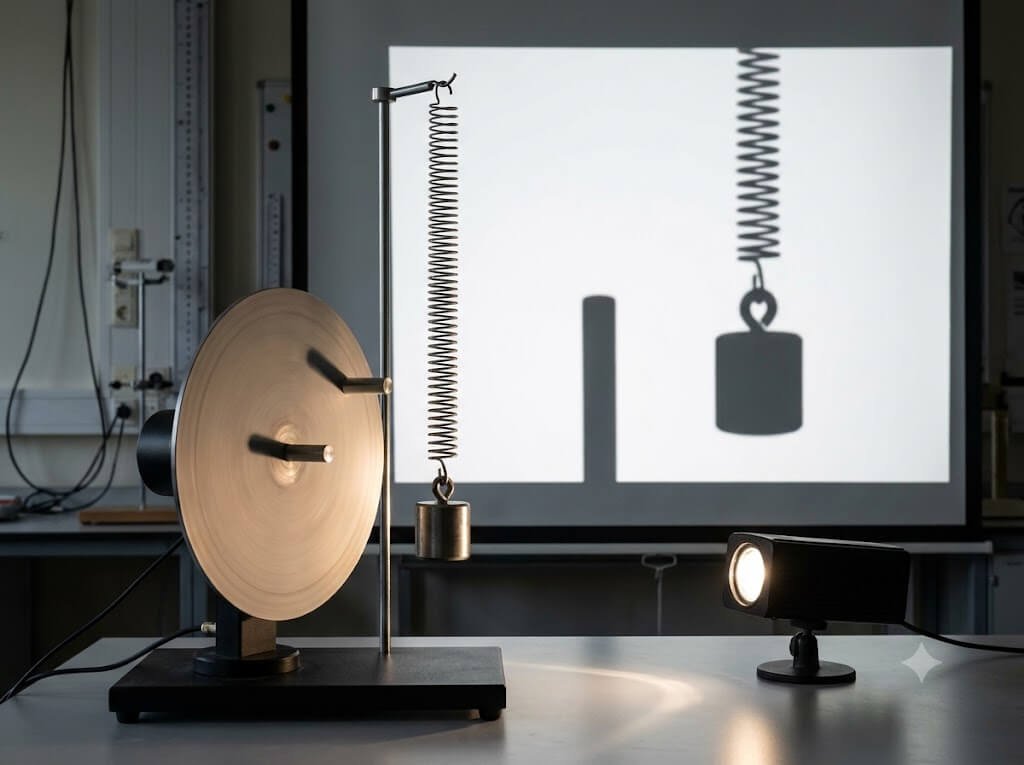
In the center of a physics lecture hall, an instructor arranges two ordinary pieces of laboratory apparatus side by side on a flat table. To the left sits a vertical turntable, motorized to rotate at a strictly constant angular speed. Fixed near the outer rim of this disc is a small spherical peg. To the right hangs a vertical helical steel spring, supporting a heavy brass bob that bobs up and down when pulled downward and released.
Observed directly from the front, these two physical phenomena appear entirely disjointed. The sphere mounted on the disc executes uniform circular motion: its distance from the hub remains constant, its linear speed never fluctuates, and its path curves smoothly through two dimensions. By contrast, the suspended brass bob is confined to a single dimension. It surges upward through the equilibrium position at maximum velocity, bleeds kinetic energy as it stretches against gravity and tension, halts instantaneously at its upper limit, and plunges back downward to repeat the cycle.
The conceptual gulf between constant angular velocity and varying linear acceleration seems vast. Yet, the moment the overhead room lights are extinguished and a single point light source—such as an arc lamp or a parallel-beam projector—is placed far to the side, the two phenomena merge. The light beam aligns parallel to the plane of the rotating disc and perpendicular to a flat white projection screen mounted behind the table.
On the screen, two distinct, crisp black silhouettes appear side by side. As the turntable’s rotation rate is tuned to match the natural bouncing frequency of the spring, an extraordinary transformation occurs: the two shadows move in locked, flawless synchrony. The circular orbit of the ball collapses into a purely linear path whose position, speed, and acceleration track the bobbing weight at every fraction of a second.
Projective Geometry: How a Circle Flattens into a Line
To understand why this equivalence exists, one must examine the mathematics of projection. Consider a coordinate system placed at the center of the rotating disc, with the horizontal axis labeled x and the vertical axis labeled y. Let the disc have a radius $R$ and rotate counterclockwise with a constant angular frequency $\omega$ (measured in radians per second).
At any given time $t$, the angular position of the peg is given by:
$$\theta(t) = \omega t + \phi$$
where $\phi$ represents the initial phase angle at $t = 0$.
Because the peg traces a circular orbit, its Cartesian coordinates at any instant are:
$$x(t) = R \cos(\omega t + \phi)$$
$$y(t) = R \sin(\omega t + \phi)$$
When the light source casts a parallel beam along the horizontal axis, the x-dimension is compressed to zero from the perspective of the screen. The shadow captures only the vertical elevation of the ball—its projection onto the y-axis:
$$y_{\text{shadow}}(t) = R \sin(\omega t + \phi)$$
Although the ball moves at a constant tangential speed $v = \omega R$, the vertical component of that speed is not constant. Taking the first time derivative reveals the velocity of the shadow:
$$v_y(t) = \frac{d}{dt}[y_{\text{shadow}}(t)] = \omega R \cos(\omega t + \phi)$$
Differentiating once more yields the acceleration of the shadow:
$$a_y(t) = \frac{d^2}{dt^2}[y_{\text{shadow}}(t)] = -\omega^2 R \sin(\omega t + \phi) = -\omega^2 y_{\text{shadow}}(t)$$
This reveals the defining kinematic fingerprint: the acceleration of the shadow is directly proportional to its displacement from the central axis, and directed oppositely toward the center.
When the peg reaches the very top or bottom of the disc, its motion is purely horizontal, meaning its instantaneous vertical velocity is zero. At these turning points, its shadow comes to a dead stop. When the peg passes through the horizontal equator of the disc, its motion is purely vertical, maximizing the shadow’s speed.
Hooke’s Law and Linear Restoring Forces
Now consider the mechanical system beside the disc: the mass suspended on the spring. When displaced from its rest position by an amount $y$, the spring exerts a restoring force according to Hooke’s Law:
$$F_{\text{restoring}} = -k y$$
where $k$ represents the spring stiffness constant in newtons per meter. The negative sign signifies that the force always acts in opposition to the displacement, driving the mass back toward equilibrium.
Applying Newton’s second law ($F = m a$):
$$m \frac{d^2 y}{dt^2} = -k y$$
Rearranging this differential equation into standard form:
$$\frac{d^2 y}{dt^2} + \left(\frac{k}{m}\right) y = 0$$
If we define a constant $\omega_0 = \sqrt{\frac{k}{m}}$, the equation becomes:
$$\frac{d^2 y}{dt^2} + \omega_0^2 y = 0$$
The general solution to this second-order linear differential equation is:
$$y_{\text{spring}}(t) = A \sin(\omega_0 t + \delta)$$
where $A$ represents the amplitude of the bounce and $\delta$ is an initial phase offset determined by how the weight was released.
Notice the structural identity between the equation governing the vertical coordinate of the rotating peg and the equation describing the spring. When the disc’s radius $R$ equals the bounce amplitude $A$, and the turntable’s angular speed $\omega$ is tuned to match the natural frequency $\omega_0$, both functions become mathematically indistinguishable:
$$y_{\text{shadow}}(t) \equiv y_{\text{spring}}(t)$$
The shadow of the rotating ball does not merely approximate the bouncing weight; it satisfies the exact same governing differential equation.
Deriving the Period Without Calculus
This optical alignment provides an intuitive geometric pathway to derive the fundamental period formula for an oscillating spring, bypassing the need for differential calculus.
In uniform circular motion, a particle traveling in a circle of radius $R$ experiences a continuous centripetal acceleration directed strictly toward the center:
$$a_c = \frac{v^2}{R} = \omega^2 R$$
The vertical component of this centripetal acceleration vector is:
$$a_y = -a_c \sin(\theta) = -(\omega^2 R) \left(\frac{y}{R}\right) = -\omega^2 y$$
For the shadow of the spring and the shadow of the ball to coincide at every point, the physical acceleration experienced by the oscillating mass must match the projected centripetal acceleration of the ball:
$$a_{\text{spring}} = a_y$$
From Newton’s second law applied to Hooke’s Law:
$$a_{\text{spring}} = -\frac{k}{m} y$$
Equating the two expressions:
$$-\frac{k}{m} y = -\omega^2 y$$
Dividing both sides by $-y$ eliminates the displacement variable entirely:
$$\omega^2 = \frac{k}{m} \implies \omega = \sqrt{\frac{k}{m}}$$
Because the turntable completes one full rotation of $2\pi$ radians in time $T$, its angular speed is simply $\omega = \frac{2\pi}{T}$. Substituting this into the frequency relationship yields:
$$\frac{2\pi}{T} = \sqrt{\frac{k}{m}}$$
Inverting both sides and isolating the period $T$:
$$T = 2\pi \sqrt{\frac{m}{k}}$$
Without solving differential equations or computing integrals, the geometric shadow reveals the core rules governing the spring:
- The period is proportional to the square root of the mass ($m$): adding inertia slows down the cycle.
- The period is inversely proportional to the square root of stiffness ($k$): a tighter, stiffer spring drives a faster oscillation.
- The period is independent of the amplitude ($A$): whether the bounce is small or large, the cycle duration remains constant (isochronism).
Phasors and Harmonic Motion Across Modern Physics
The equivalence demonstrated by the shadows is the foundation of simple harmonic motion (SHM) and the concept of the phasor—a rotating vector whose projection represents an oscillating quantity.
This geometric insight extends far beyond mechanical springs:
1. Sound Waves and Musical Acoustics
When a guitar string is plucked or a column of air resonates inside a flute, the localized air pressure oscillates back and forth. The resulting pure tone (a sinusoidal acoustic wave) can be represented mathematically as the projected shadow of a vector spinning at the audio frequency. Complex musical timbres, comprised of fundamental frequencies and overtones, are simply the sum of multiple projected circular vectors of varying radii and rotational speeds (Fourier analysis).
2. Alternating Current (AC) Electronics
In power distribution networks and radio transceivers, electrical potential and current oscillate sinusoidally:
$$V(t) = V_0 \cos(\omega t)$$
Electrical engineers analyze circuits containing inductors, capacitors, and resistors using phasor diagrams. Instead of manipulating complex differential equations describing charge buildup and magnetic induction, currents and voltages are treated as rotating arrows on a two-dimensional plane. Their instantaneous real-world values correspond to the horizontal projections (“shadows”) of those arrows.
3. Quantum Mechanics
In quantum theory, the state of an undisturbed particle is described by a wave function that evolves according to the time-dependent Schrödinger equation:
$$\Psi(x, t) = \psi(x) e^{-i E t / \hbar}$$
The time-dependent term $e^{-i E t / \hbar}$ describes a complex number tracing a circle of unit radius in the complex plane at an angular rate proportional to the particle’s energy $E$. The observable oscillations and stationary states of matter are deeply rooted in this exact circular rotation projected into physical reality.
The Universal Perspective
The shadow experiment remains a foundational demonstration in classical physics because it forces an observer to reconsider perspective.
A system can appear non-linear, halting, and variable when viewed head-on in its natural dimension. Yet, when viewed as a projection of a higher-dimensional state—a two-dimensional circle viewed strictly edge-on—the underlying dynamics resolve into steady, unbroken, uniform symmetry.
Every vibration in nature, from the sway of a skyscraper in the wind to the electromagnetic ripple of a distant star’s light, shares this underlying geometry: a steady circular journey viewed from the side.
Frequently Asked Questions (FAQ)
What is the relationship between uniform circular motion and simple harmonic motion?
Simple harmonic motion (SHM) is the one-dimensional projection of uniform circular motion. When an object moves along a circular path at a constant speed, its shadow—cast edge-on onto a flat surface—moves strictly back and forth along a straight line, rising and falling with the exact acceleration and velocity profile of an oscillating mass on a spring.
Why do the two shadows move in unison?
Both systems share the same mathematical relationship between displacement and acceleration. In circular motion, the vertical component of the object’s centripetal acceleration is directly proportional to its vertical displacement from the center:
$$a_y = -\omega^2 y$$
In a mass-spring system, Hooke’s Law creates a restoring force proportional to displacement ($F = -ky$), resulting in an identical linear acceleration:
$$a = -\left(\frac{k}{m}\right)y$$
When the angular frequency of the rotating disc matches the natural frequency of the spring ($\omega = \sqrt{k/m}$), the two motions are mathematically identical.
Why does the shadow of the rotating ball slow down at the ends and speed up in the middle?
Even though the ball travels at a constant linear speed along the perimeter of the circle, its directional velocity changes continuously:
- At the top and bottom: The ball moves purely horizontally (tangent to the circle), meaning its vertical component of velocity is zero. Consequently, its shadow pauses instantaneously at the turning points.
- At the center equator: The ball moves purely vertically, meaning its entire velocity contributes to the vertical axis, causing the shadow to reach its maximum speed.
How does this demonstration simplify calculating the period of a spring?
Normally, finding the period of a mass-spring system requires setting up and solving a second-order differential equation. Using the shadow demonstration, you can equate the vertical projection of centripetal acceleration ($\omega^2 y$) directly to the mechanical acceleration from Hooke’s Law ($\frac{k}{m}y$). Setting $\omega = \sqrt{\frac{k}{m}}$ and substituting the relationship for a full rotation ($\omega = \frac{2\pi}{T}$) directly produces the standard period formula:
$$T = 2\pi \sqrt{\frac{m}{k}}$$
Does this principle apply to oscillations beyond mechanical springs?
Yes. This equivalence forms the basis of phasor analysis, which is widely used across modern physics and engineering:
- Acoustics: Pure sound tones and musical harmonics are analyzed as projected rotational frequencies.
- Electronics: Alternating currents (AC) and voltages are represented as rotating vectors to calculate impedance and phase shifts.
- Quantum Mechanics: The wave function of a quantum state oscillates through the complex plane via the phase factor $e^{-iEt/\hbar}$, mirroring the steady circular journey at the heart of harmonic motion.