
The Viral Myth of the Anti-Thermal Umbrella
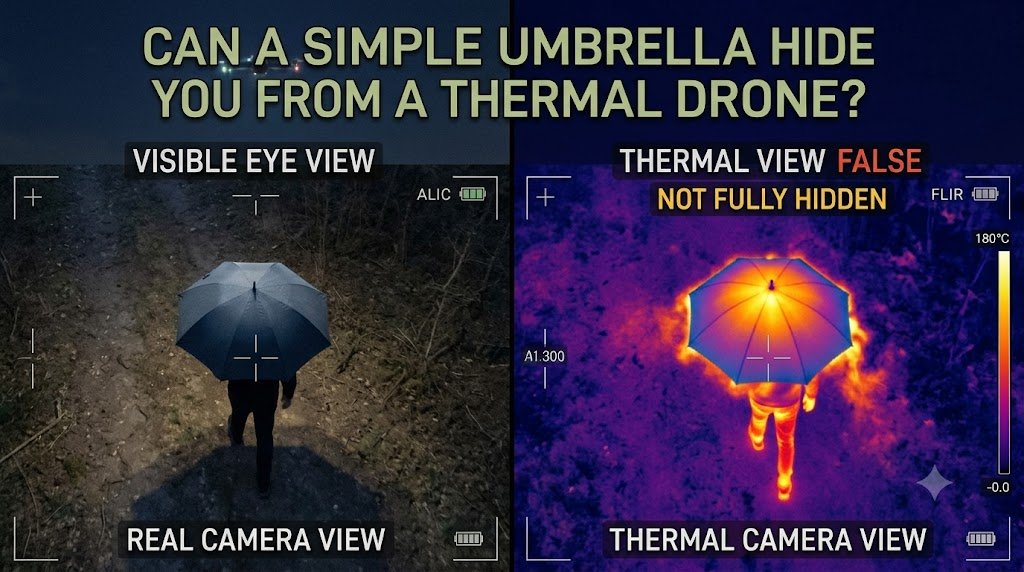
In recent years, short-form video platforms and survivalist forums have popularized a striking visual: an individual walking under an ordinary nylon umbrella, seemingly disappearing from an overhead thermal camera’s display. The implication is straightforward and tempting—that a five-dollar household item can defeat state-of-the-art military and law enforcement surveillance drones.
While the demonstration relies on genuine physics, the conclusion drawn from it is largely a tactical illusion. Understanding why an umbrella appears to work in controlled demonstrations—and why it fails drastically in real-world scenarios—requires examining how long-wave infrared (LWIR) imaging operates, how heat transfers through materials, and how modern automated aerial reconnaissance functions.
The Physics Behind the Illusion: What Thermal Sensors Actually See
To evaluate the umbrella defense, one must first dismantle a common misconception: thermal cameras do not have X-ray vision, nor do they look inside objects. They are passive radiometers designed to detect infrared radiation—primarily in the 8 to 14 micrometer wavelength spectrum—emitted from the exterior surfaces of objects.
The intensity of this radiation depends on two physical factors:
- Surface Temperature: Warmer surfaces emit more infrared energy than colder surfaces.
- Surface Emissivity: The efficiency with which an object’s surface radiates heat compared to an ideal black body.
When an overhead drone camera looks down, it measures the temperature of the first solid or opaque surface in its optical path. An umbrella made of woven synthetic fabric such as polyester or nylon is completely opaque to long-wave infrared radiation.
At the exact moment an umbrella is opened above a human body, it physically blocks the thermal sensor’s direct line of sight to the subject’s 37°C (98.6°F) skin and clothing. The drone’s sensor registers only the top exterior fabric of the umbrella, which initially remains at the ambient air temperature. To a casual observer watching a top-down thermal monitor, the warm human silhouette appears to vanish instantly, replaced by a circular patch matching the cooler background.
Why the Umbrella Defense Fails in Practice
The apparent success of this technique is brief and highly conditional. In practical, real-world deployment, several thermodynamic, geometric, and computational factors cause the umbrella shield to fail almost immediately.
1. Thermal Transfer and Canopy Saturation
An umbrella does not eliminate heat; it merely traps it. A human body at rest produces between 80 and 100 watts of thermal energy through metabolic processes, an output that increases significantly during movement or stress.
This thermal energy moves rapidly toward the umbrella canopy through three mechanisms:
- Convection: Warm air rises directly into the concave interior of the canopy, forming an insulated pocket of trapped hot air.
- Conduction: Because standard umbrella canopies consist of an ultra-thin single layer of synthetic fabric (often mere fractions of a millimeter thick), heat conducts rapidly from the warm underside to the exterior surface.
- Thermal Bloom: Within three to five minutes, the exterior surface of the umbrella heats up. On a thermal screen, the umbrella ceases to look neutral; it begins to glow brightly against the colder environment, serving as an amplified beacon rather than camouflage.
2. Angular Visibility and Thermal Spill
Viral demonstrations almost exclusively position the thermal camera directly overhead at a 90-degree zenith angle. Drones in practical operations rarely hover directly over a target:
- Oblique Sightlines: Drones typically orbit at slant angles ranging from 30 to 60 degrees to maximize field of view, avoid acoustic detection, and track lateral movement.
- Exposed Extremities: At an angle, an umbrella canopy only obscures the head and upper shoulders. The subject’s arms, legs, warm footwear, and exhaled breath (which creates an unmistakable thermal plume in cool air) remain in full view of the sensor.
- Thermal Reflection: Even if the direct body heat is partially shielded, heat reflected off the ground surface beneath the canopy can be captured by sensitive microbolometers.
3. Negative Contrast and Algorithmic Detection
Camouflage is not simply about being cold; it is about matching the environment.
A perfectly geometric circle or octagon traveling across an organic background—such as a forest floor, an open field, or a paved roadway—creates what imaging analysts call “negative thermal contrast.” Modern military and commercial reconnaissance drones are equipped with computer vision and automatic target recognition (ATR) algorithms. These systems do not merely search for hot spots; they track anomalous edge contours, unnatural geometric symmetry, and motion vectors. A circular void of uniform temperature moving linearly across textured ground triggers automated tracking just as effectively as a bright heat signature.
Specialized Countermeasures vs. Everyday Fabrics
True thermal mitigation requires specialized materials engineered to address the three primary failure points of everyday fabrics:
| Feature | Standard Nylon Umbrella | Engineered Multispectral Screen |
| Infrared Opacity | Blocks immediate direct line of sight | Blocks direct line of sight |
| Thermal Insulation | Minimal; heat conducts through fabric within minutes | High; multi-layer aerogels or air gaps arrest heat transfer |
| Low-Emissivity Lining | Absent; exterior radiates trapped heat quickly | Present; metallized/reflective layers scatter heat internally |
| Geometric Disruption | Distinct circular or polygonal silhouette | Irregular jagged edges designed to blend with natural background |
| Ventilation Control | Heat collects under canopy | Baffled venting disperses heat laterally to prevent pooling |
Products such as thermal-reflective tarps (often incorporating vapor-deposited aluminum) or multispectral ghillie fabrics succeed where umbrellas fail because they combine physical opacity with insulation, low surface emissivity, and silhouette-breaking textures.
Realistic Assessment
The claim that an umbrella can hide a person from a thermal drone contains a grain of scientific truth that has been distorted into dangerous misinformation. While an umbrella momentarily intercepts the direct optical pathway of infrared radiation from directly above, it fails almost immediately against heat accumulation, oblique observation angles, and automated algorithmic tracking. In any scenario involving modern thermal surveillance, relying on a simple umbrella offers only a brief and fleeting psychological comfort rather than genuine concealment.
Frequently Asked Questions (FAQ)
Can a regular umbrella hide your body heat from a thermal drone?
A standard umbrella can only obscure your body heat momentarily from a direct top-down angle. While synthetic fabric is opaque to infrared radiation and briefly creates a physical barrier, body heat quickly collects under the canopy, warms the fabric, and makes it visible on thermal optics within minutes.
Why do umbrellas appear to work in viral social media videos?
Demonstrations online are almost always filmed under artificial, best-case conditions. The camera is typically placed directly overhead at a 90-degree zenith angle, and the clip lasts only a few seconds before rising body heat warms the umbrella surface or leaks out from the sides.
How quickly does an umbrella start glowing on a thermal camera?
Under normal conditions, an umbrella canopy begins warming up within three to five minutes of an individual standing or walking underneath it. Convection traps hot air beneath the canopy, and conduction transfers that thermal energy to the exterior fabric, creating an obvious thermal bloom.
At what angles can a thermal drone still spot you under an umbrella?
Modern surveillance drones rarely hover directly above targets; they generally observe from oblique angles between 30 and 60 degrees. From these vantage points, an umbrella fails to shield your arms, legs, footsteps, and exhaled breath.
What materials can actually shield against thermal imaging?
Effective thermal mitigation requires engineered multispectral barriers that combine high thermal insulation, low surface emissivity, and silhouette-breaking shapes. Materials like heavy insulated space blankets, vapor-deposited aluminum layers, and specialized thermal ghillie suits scatter heat internally and prevent external surface warming far better than thin umbrella fabric.