
The Architecture of Dots and Dashes: How Morse Code Engineered the Modern World
Long before the advent of fiber optics, wireless packet networks, or voice telephony, human civilization faced an unyielding physical constraint: information could travel no faster than a physical messenger on foot, on horseback, or via steam locomotive. The dawn of the electric telegraph in the early nineteenth century severed the connection between transportation and communication, enabling thoughts to move at the speed of electrical conduction.
At the nucleus of this technological breakthrough was not merely copper wire or wet-cell batteries, but an abstract encoding schema: Morse code. By translating human language into the binary interplay of duration and silence, Morse code laid the philosophical and structural groundwork for modern telecommunications, computing, and global network architecture.
Origins and the Mechanical Leap
The development of the system is historically credited to American inventor Samuel F. B. Morse and his associate Alfred Vail during the late 1830s. Morse envisioned the electrical apparatus, but Vail was largely responsible for refining the operational alphabet into an efficient, practical encoding system.
Prior systems of optical signaling—such as French engineer Claude Chappe’s semaphore lines—relied on line-of-sight towers with mechanical arms. While functional across clear horizons, these networks were rendered useless by fog, darkness, and rain. The electrical telegraph eliminated geographic and visual limitations entirely, requiring an alphabet that could travel over a simple, singular electrical line.
On May 24, 1844, Morse transmitted the historic message from the U.S. Capitol in Washington, D.C., to the Mount Clare Station in Baltimore:
“What hath God wrought!”
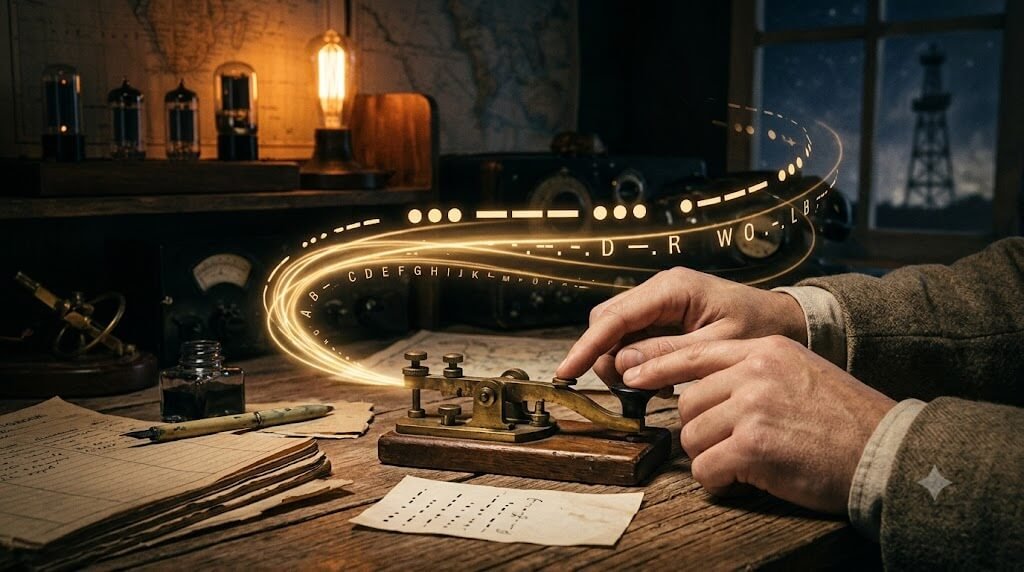
The signal was recorded as indents on a moving paper tape. However, human telegraph operators quickly discovered an unintended human capability: they could decipher the rhythms directly from the audible mechanical clicks produced by the receiver’s electromagnet, rendering paper rolls obsolete and birthing auditory telegraphy.
Anatomy of the Language: Mechanics, Timing, and Optimization
Morse code is fundamentally a variable-length pulse-duration system. Rather than allocating identical computational weight to every character, the system was meticulously optimized around natural language statistics.
The Statistical Ingenuity of Vail’s Design
To minimize transmission time, Alfred Vail conducted a survey of type cases in a local newspaper printing office. He discovered that the letter E appeared with the greatest frequency in English text, followed by T, while letters like Q, Z, and X were exceedingly rare.
Consequently, Vail assigned the simplest, most rapid transmission unit to the most frequent characters:
- E became a single short click:
• - T became a single long pulse:
— - Q was mapped to the longer, complex rhythm:
— — • —
This design principle was a direct precursor to modern data compression algorithms, notably Huffman coding, which similarly allocates smaller bit patterns to more frequent data tokens.
The Precision of Time Units
To ensure intelligibility across varying operational speeds, the system is governed by strict mathematical timing ratios relative to a single basic unit of duration, known as a dit:
- Dit (Dot): 1 unit of time.
- Dah (Dash): Exactly 3 units of time.
- Intra-character spacing: The gap between individual dits and dahs within the same letter is 1 unit of time.
- Inter-character spacing: The pause between adjacent letters within a word is 3 units of time.
- Inter-word spacing: The silence between distinct words is 7 units of time.
This rhythmic precision transformed an ambiguous sequence of buzzes into an exact, reproducible acoustic language capable of being transcribed at speeds upwards of thirty to forty words per minute by seasoned operators.
Evolution: American vs. International Morse Code
As telegraph networks expanded across the Atlantic, standardizations became mandatory. The original American Morse Code contained varied dash lengths, internal spacing within characters, and uneven intervals, making it prone to errors when crossing borders.
To eliminate regional inconsistencies, the International Morse Code (initially standardized at the Paris Telegraph Congress in 1865) unified all characters:
- Every dash became uniform in duration (three dits long).
- Internal spaces within letters were abolished.
- Specific diacritics and international symbols were mapped uniformly across European, Asian, and maritime operators.
This standardized dialect remains the canonical format recognized globally today.
Maritime Rescue and the Birth of SOS
The emergence of radio in the late 1890s, pioneered by Guglielmo Marconi and other wireless experimenters, extended Morse code from overland wires into free space via continuous wave (CW) radio frequencies. This proved revolutionary for ocean-going vessels, which had previously entered total isolation upon breaking sight of shore.
In 1906, the Berlin Radiotelegraphic Conference adopted a universal distress call designed for rapid, unmistakable recognition even through heavy radio static and atmospheric interference: SOS.
Contrary to popular backronyms such as “Save Our Souls” or “Save Our Ship,” the letters hold no semantic meaning. They were selected purely because their Morse sequence forms an unbroken, rhythmic pattern:
$$\text{SOS} = \bullet \bullet \bullet \text{ — — — } \bullet \bullet \bullet$$
This sequence was broadcast as a single procedural continuous character without inter-letter pauses, guaranteeing maximum auditory distinctiveness in an emergency. The Titanic’s historic sinking in April 1912 cemented the distress call’s role in maritime law, spurring global mandates for round-the-clock radio watches on passenger vessels.
The Legacy of Binary Communication
Morse code is often recognized as the direct ancestor of the binary systems that govern modern computation:
| Metric | Morse Code (Auditory/Analog) | Modern Computing (Digital) |
| Fundamental State | Presence of signal vs. Absence of signal | High voltage (1) vs. Low voltage (0) |
| Encoding Logic | Variable-length acoustic pulse duration | Fixed or variable bit-depth encoding (ASCII, UTF-8) |
| Transmission Media | Copper wire, optical flashes, RF carrier waves | Copper trace, fiber-optic light, RF Wi-Fi/LTE |
| Signal Robustness | Operable at the absolute noise floor of human hearing | Governed by Shannon-Nyquist error-correction limits |
While standard commercial maritime services officially phased out compulsory Morse code monitoring on February 1, 1999—transitioning to satellite-based frameworks like the Global Maritime Distress and Safety System (GMDSS)—Morse code has not vanished.
Contemporary Relevance
- Aviation Navigational Aids: Ground-based VHF Omnidirectional Range (VOR) and Non-Directional Beacon (NDB) transmitters still broadcast their alphanumeric call signs in Morse code to allow pilots to verify navigational signal accuracy.
- Amateur Radio (Ham): Thousands of operators worldwide continue to transmit in Continuous Wave mode because a Morse signal can penetrate geomagnetic interference, atmospheric distortion, and extreme solar storms where modern compressed digital audio feeds falter.
- Emergency Signaling: When digital electronics succumb to power loss or hardware failure, any source of light, acoustic敲, or manual switch can transmit intelligible messages without software, processing overhead, or network infrastructure.
Here are the best, classic real-world examples of Morse code in action:
1. The Most Famous Distress Call: SOS
- Plain Text:
SOS - Morse Code:
· · · — — — · · · - Why it matters: Adopted in 1906, this universal maritime distress signal was chosen specifically because of its rhythmic, unmistakable cadence. It is transmitted as one continuous run without pauses between characters so it cuts clearly through static and stormy radio waves.
2. The Historic First Telegraph Message (1844)
- Plain Text:
WHAT HATH GOD WROUGHT - Morse Code:
Plaintext· — — · · · · · — — / · · · · · — — · · · · / — — · — — — — · · / · — — — — — · · — — — · · · · · — - Why it matters: Sent on May 24, 1844, by Samuel Morse from the U.S. Capitol in Washington, D.C., to Alfred Vail in Baltimore, this marked the dawn of commercial electrical telecommunications.
3. The Coded Blink (1966)
- Plain Text:
T-O-R-T-U-R-E - Morse Code:
— — — — · — · — · · — · — · · - Why it matters: During the Vietnam War, captured U.S. Navy pilot Jeremiah Denton was forced into a televised propaganda interview. Staring directly into the camera, he repeatedly blinked his eyelids in Morse code to spell out T-O-R-T-U-R-E, alerting U.S. Naval Intelligence to the reality of prisoner conditions.
4. Basic Everyday Alphabet Reference
| Character | Morse Representation | Rhythmic Sound |
| A | · — | di-dah |
| B | — · · · | dah-di-di-dit |
| C | — · — · | dah-di-dah-dit |
| E | · | dit (most common English letter) |
| T | — | dah (second most common letter) |
| 1 | · — — — — | di-dah-dah-dah-dah |
| 5 | · · · · · | di-di-di-di-dit |
| 0 | — — — — — | dah-dah-dah-dah-dah |
Conclusion
Morse code stands as an enduring testament to conceptual simplicity. By reducing human thought to the rhythm of duration, pause, and repetition, it eliminated continental distance and laid the philosophical baseline for the information era. It is an alphabet stripped of decoration—a timeless language that requires nothing more than an interrupted line, an intuitive operator, and the will to connect across the silence.
Frequently Asked Questions (FAQ)
What is Morse code and how does it work?
Morse code is a method of telecommunication that encodes text characters into standardized sequences of two distinct signal durations: short signals called dots (or dits) and long signals called dashes (or dahs). These signals can be transmitted using sound pulses, electric telegraph clicks, flashing lights, or radio waves.
Who invented Morse code?
Morse code was developed in the 1830s and 1840s by American inventor Samuel F. B. Morse along with his collaborator Alfred Vail, who played a major role in optimizing the code and assigning shorter sequences to more frequently used letters.
What is the timing rule for dots and dashes in Morse code?
International Morse code follows a standard timing ratio:
- A dash equals the length of 3 dots.
- The silence between components of the same letter equals 1 dot.
- The pause between letters within a word equals 3 dots.
- The space between words equals 7 dots.
What does the SOS distress signal stand for?
Contrary to popular belief, SOS does not stand for “Save Our Ship” or “Save Our Souls.” It was chosen at the 1906 International Radiotelegraphic Convention because its continuous pattern (• • • — — — • • •) is distinct, unmistakable, and easy to transmit without pausing between characters.
Is Morse code still used today?
Yes. While international maritime treaties officially phased out commercial Morse code monitoring in 1999 in favor of satellite communications, Morse code is still used by amateur radio operators, serves as continuous-wave identification for aviation navigational beacons (VOR and NDB), and remains a vital low-bandwidth backup during emergency communications.