
The Weightless Particle: Does Light Have Mass?
In everyday experience, things that interact with the physical world carry weight. A baseball hitting a glove, raindrops striking a windshield, or dust settling on furniture all rely on mass to exert force. Because light illuminates objects, exerts measurable pressure, and leaves permanent impressions on photographic surfaces, it is natural to assume that it must possess some form of physical weight.
In modern physics, the answer is precise: light does not have mass.
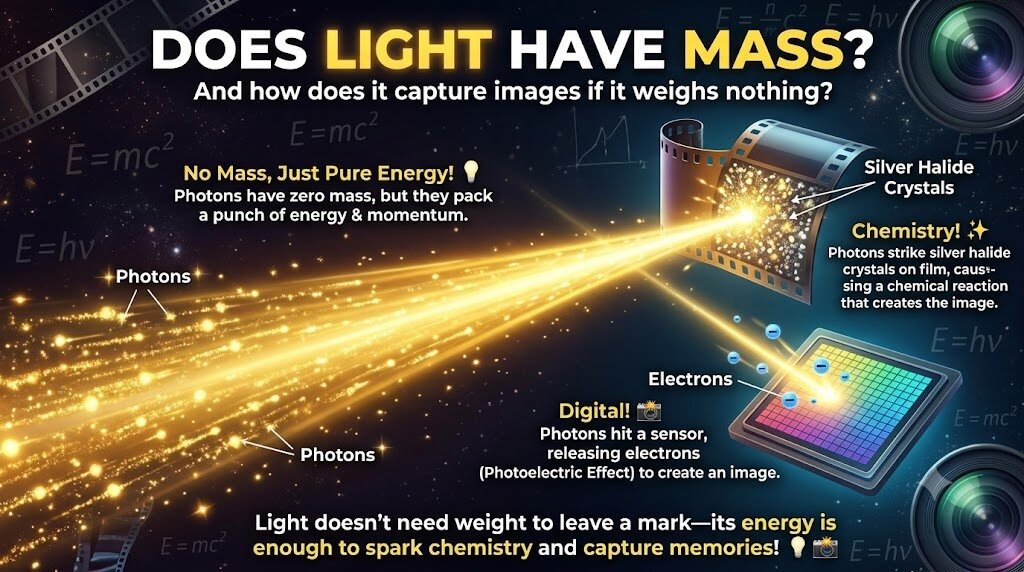
To understand why, light must be viewed at the subatomic scale. A beam of light consists of elementary particles known as photons. According to the Standard Model of particle physics, photons have zero invariant mass (often referred to as rest mass).
Under Einstein’s theory of Special Relativity, the relationship governing mass, energy, and momentum is expressed as:
$$E^2 = (pc)^2 + (m_0 c^2)^2$$
Where:
- $E$ is total energy
- $p$ is momentum
- $c$ is the speed of light in a vacuum
- $m_0$ is rest mass
If an object is stationary ($p = 0$), the equation simplifies to the well-known $E = m_0 c^2$. However, a photon is never at rest; it always travels at speed $c$ in a vacuum. Because its rest mass ($m_0$) equals zero, the equation simplifies differently for light:
$$E = pc$$
This reveals a fundamental truth of our universe: an entity can possess energy and momentum without carrying any mass at all. The energy of an individual photon depends entirely on its frequency ($\nu$), defined by Max Planck’s quantum relation:
$$E = h\nu$$
Because photons carry momentum, they can push against matter—a phenomenon known as radiation pressure—and initiate atomic reactions without needing a single gram of physical mass.
The Chemistry of Capture: How Weightless Light Exposes Film
If light has no mass to physically dent or mechanically push onto a surface, how does a photograph form? The answer lies in quantum chemistry, not mechanical force.
Capturing an image is the process of converting the kinetic electromagnetic energy of incoming photons into stable chemical changes.
1. The Structure of Photographic Film
Traditional photographic film consists of a flexible, transparent base (typically cellulose acetate or polyester) coated with an emulsion layer. This emulsion is a gelatin suspension holding billions of microscopic crystals of silver halides—primarily silver bromide ($\text{AgBr}$) or silver chloride ($\text{AgCl}$).
In an unexposed crystal lattice, positively charged silver ions ($\text{Ag}^+$) and negatively charged halide ions ($\text{Br}^-$) exist in a delicate chemical balance.
2. The Photoelectric Interaction and the Gurney-Mott Theory
When the camera shutter opens, light passes through the lens and strikes the film emulsion. What follows is explained by the Gurney-Mott mechanism:
- Electron Excitation: When a photon carrying sufficient quantum energy ($h\nu$) strikes a bromide ion ($\text{Br}^-$) inside a crystal, the photon is absorbed. Its energy is transferred to an electron within the ion’s outer shell, knocking it free into the crystal’s conduction band:
$$\text{Br}^- + h\nu \longrightarrow \text{Br} + e^-$$ - Trapping the Electron: The freed electron travels rapidly through the crystal lattice until it encounters an imperfection, crystal defect, or chemical sensitizer site, commonly referred to as a “sensitivity speck” (an electron trap).
- Formation of Metallic Silver: Once trapped, the negative charge attracts a mobile interstitial silver ion ($\text{Ag}^+$) within the lattice. When the positive ion reaches the trap, it neutralizes the electron, precipitating a single atom of metallic, elemental silver:
$$\text{Ag}^+ + e^- \longrightarrow \text{Ag}^0$$
3. The Latent Image
A single metallic silver atom is unstable and will quickly decay back into an ion. However, if the exposure continues and additional photons strike the same microscopic crystal, more electrons are released and trapped at the same site.
Once four or more metallic silver atoms cluster together ($\text{Ag}_4^0$), the cluster becomes thermodynamically stable. This microscopic cluster of metallic silver is called a latent image center.
At this stage, the film still looks completely unchanged to the human eye. The image is invisible, encoded as an atomic pattern across millions of individual grain boundaries.
4. Chemical Amplification: Development
The conversion of the invisible latent image into a visible picture demonstrates the efficiency of photon energy:
- Development: The exposed film is submerged in a chemical reducing agent (the developer). The developer donates electrons to reduce silver ions into metallic silver, but it acts exponentially faster on crystals that already possess a stable latent image cluster. The cluster acts as a catalyst, causing the entire crystal to be reduced into opaque, black metallic silver filaments.
- Amplification Factor: Through this chemical development, an initial exposure of merely a few photons per grain is amplified by a factor of roughly one billion ($10^9$).
- Fixing: A fixing solution (typically ammonium or sodium thiosulfate) dissolves and washes away all unexposed, unreacted silver halide crystals, leaving only the stable black metallic silver suspended in the gelatin.
- Washing and Drying: After thorough washing, the negative is complete: dense metallic silver clusters block light in areas that received high illumination, while clear areas correspond to shadows where few or no photons arrived.
Analogy to Digital Sensors
Modern digital photography relies on the exact same fundamental principle: energy transfer, not mass impact.
Instead of triggering chemical bonds in silver crystals, photons strike a silicon photodiode inside a CMOS or CCD sensor. Through the internal photoelectric effect, each absorbed photon promotes an electron from the valence band to the conduction band of the silicon, creating an electron-hole pair. These liberated charges are accumulated in potential wells, converted into voltage, and quantified via an analog-to-digital converter into raw numerical pixel values.
Summary
Light does not need mass to leave an indelible mark on reality. It operates through the currency of pure energy.
When you capture a photograph, the lens is not catching particles of matter falling like dust onto paper. Instead, it directs electromagnetic energy packets that trigger an atomic-scale chain reaction—knocking electrons from their orbits, shifting chemical bonds, and transforming transient waves into a permanent visual record.
Frequently Asked Questions (FAQ)
Does light have any mass at all?
No, light has zero rest mass (invariant mass). Light particles, known as photons, are pure electromagnetic energy moving at the speed of light ($c$). Because they cannot be brought to rest, they possess no rest mass according to the Standard Model of particle physics.
If light has no mass, how does it exert force or push things?
While photons have no mass, they do possess momentum ($p = \frac{h}{\lambda} = \frac{E}{c}$). When photons strike a reflective or absorbent surface, they transfer this momentum, creating radiation pressure. This allows light to exert physical push on objects like solar sails in space without carrying any weight.
Why does film capture an image if light cannot physically strike it with weight?
Capturing an image on film is a chemical reaction rather than a mechanical impact. Photographic film is coated with light-sensitive silver halide crystals. When a photon strikes a crystal, its energy knocks an electron free, converting a silver ion into a microscopic atom of elemental metallic silver.
What is the latent image in photography?
The latent image is the invisible, microscopic pattern of metallic silver atom clusters formed on film upon exposure to photons. It remains undetectable to the human eye until a chemical developer amplifies these minute clusters into dense, visible metallic silver grains.
How do modern digital camera sensors compare to film when capturing light?
Digital sensors use the photoelectric effect rather than chemical emulsion. Photons strike silicon photodiodes on a sensor chip (CMOS or CCD), exciting electrons from the valence band to the conduction band. These released electrons generate an electric charge that is measured, amplified, and converted into digital pixel values.