Claude Debussy: The Composer Who Changed the Sound of Modern Music
Claude Debussy was one of the most original and influential composers to emerge at the end of the 19th century. At a time when European classical music was still strongly shaped by established rules of harmony, form and development, Debussy searched for a different musical language—one built around colour, atmosphere, suggestion, rhythm and the beauty of sound itself.
Born Achille Claude Debussy on 22 August 1862 in Saint-Germain-en-Laye, France, he became an important figure in the transition from 19th-century Romanticism to modern music. He is frequently described as an Impressionist composer, although Debussy himself strongly objected to that label.
Works such as Clair de Lune, Prélude à l’après-midi d’un faune, La mer, Nocturnes, Images and the opera Pelléas et Mélisande remain central to his reputation. Yet Debussy’s importance goes beyond a collection of famous compositions. His experiments with harmony, scales, orchestral colour and musical structure helped open possibilities that later composers would explore throughout the 20th century.
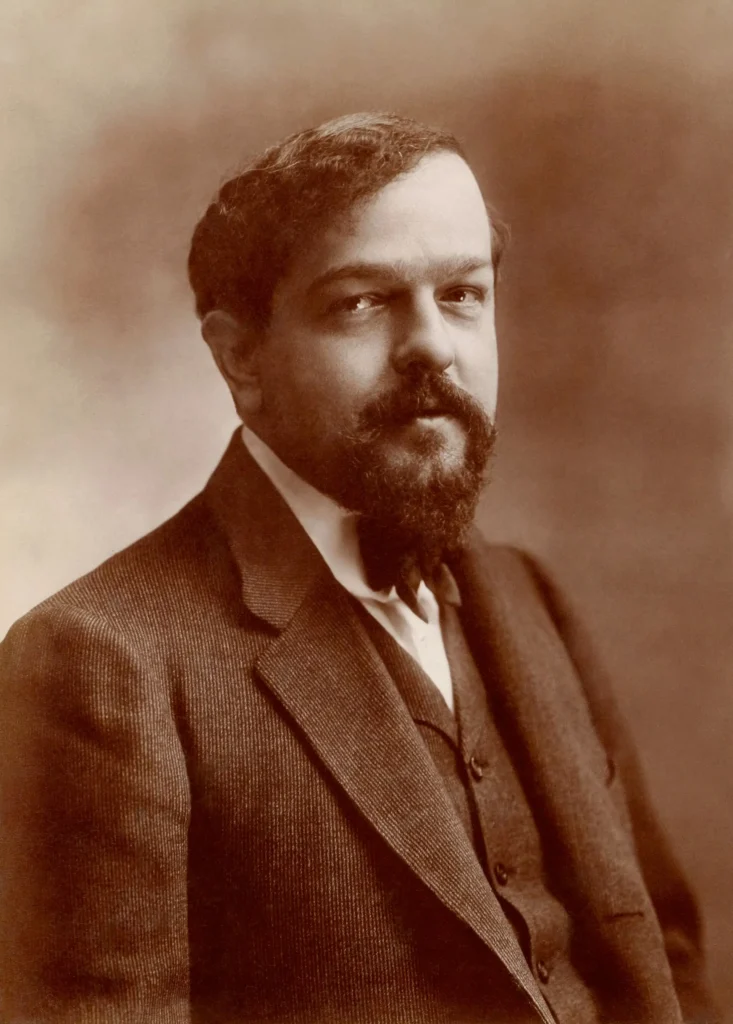
Claude Debussy at a Glance
| Detail | Information |
|---|---|
| Full name | Achille Claude Debussy |
| Born | 22 August 1862 |
| Birthplace | Saint-Germain-en-Laye, France |
| Nationality | French |
| Profession | Composer |
| Musical period | Late Romantic / early modern |
| Commonly associated style | Impressionism in music, although Debussy rejected the label |
| Major award | Prix de Rome, 1884 |
| Famous opera | Pelléas et Mélisande |
| Famous piano work | Clair de Lune |
| Major orchestral works | Prélude à l’après-midi d’un faune, Nocturnes, La mer, Images |
| Died | 25 March 1918 |
| Age at death | 55 |
| Place of death | Paris, France |
| Burial place | Passy Cemetery, Paris |
Debussy wrote orchestral music, piano pieces, songs, chamber works and stage music. His catalogue includes 24 Préludes and 12 Études for piano, while his orchestral output includes Prélude à l’après-midi d’un faune, Nocturnes, La mer and Images.
Early Life and Family Background
Debussy was born on 22 August 1862 in Saint-Germain-en-Laye, on the north-western outskirts of Paris. He was the eldest of five children of Manuel-Achille Debussy and Victorine Manoury Debussy.
His family was not wealthy or deeply involved in professional music. His father operated a china shop, while his mother worked as a seamstress. After the shop failed, the family eventually moved to Paris.
Nothing about these circumstances made an international musical career inevitable.
The turning point came during childhood.
During the Franco-Prussian War, Debussy’s mother took him and his sister to Cannes. There, when Debussy was about seven, he received his first piano lessons from the Italian musician Jean Cerutti. He subsequently studied with Antoinette Mauté de Fleurville.
His musical ability developed rapidly.
Admission to the Paris Conservatoire
In 1872, at only ten years old, Debussy was admitted to the prestigious Conservatoire de Paris.
He remained there for approximately eleven years.
His studies included piano, solfège, harmony, composition and organ. Among his teachers were Antoine François Marmontel, Albert Lavignac, Ernest Guiraud, Émile Durand and César Franck.
Debussy initially appeared capable of becoming a professional pianist. He was a talented performer and particularly strong at sight-reading. However, his relationship with formal musical education was complicated.
Some teachers recognised his artistic potential, while others regarded him as careless or insufficiently disciplined. More importantly, Debussy gradually became dissatisfied with the conventional rules surrounding composition.
That tension between academic tradition and individual freedom became one of the defining forces of his career.
Debussy’s First Compositions
Debussy’s earliest compositions date from around 1879. During that period, he worked as a resident pianist at the Château de Chenonceau.
Among his early compositions were settings of poems by Alfred de Musset.
In the following years, Debussy worked as a pianist for Nadezhda von Meck, who is also remembered as an important patron of Pyotr Ilyich Tchaikovsky. Debussy travelled with her family through France, Switzerland and Italy and also visited Moscow. During this period he composed his Piano Trio in G major and arranged music from Tchaikovsky’s Swan Lake for piano duet.
These experiences exposed the young composer to a much broader musical world than the classrooms of the Conservatoire alone could provide.
Winning the Prix de Rome
A major milestone arrived in 1884, when Debussy won the prestigious Prix de Rome with his cantata L’enfant prodigue.
The award allowed him to live and study at the Villa Medici, home of the French Academy in Rome. He stayed there primarily between January 1885 and March 1887.
Winning the prize was a considerable achievement, but life in Rome did not make Debussy more conventional.
Quite the opposite.
He found the artistic environment restrictive and often struggled with the expectations placed upon prize-winning composers. The works he submitted to the Academy included Zuleima, Printemps, La Damoiselle élue and the Fantaisie for piano and orchestra.
The Academy was troubled by aspects of his increasingly unconventional musical language. Yet those very tendencies eventually helped make Debussy historically important.
Wagner’s Influence—and Debussy’s Search for Independence
After returning to Paris in 1887, Debussy encountered the music of Richard Wagner intensely.
He attended Wagner performances and visited the Bayreuth Festival in 1888 and 1889. Wagner’s rich harmonies, dramatic scale and approach to musical form initially fascinated him.
But Debussy did not want French music simply to imitate Wagner.
He eventually moved away from the German composer’s influence and searched for a musical identity of his own.
This search became essential to the development of his mature style.
The 1889 Paris Exposition and Javanese Gamelan
One of the most important encounters in Debussy’s artistic development occurred at the 1889 Paris Exposition Universelle.
There he heard Javanese gamelan music.
The experience exposed him to musical structures, rhythms, scales and textures that differed significantly from mainstream European classical traditions.
The gamelan’s layered sonorities and distinctive scales fascinated him. Elements associated with this experience can later be heard in works such as “Pagodes” from Estampes.
Debussy was not simply copying gamelan music. Rather, the encounter demonstrated that music did not have to follow the harmonic assumptions dominant in European academic composition.
This helped expand his musical imagination.
The Birth of Debussy’s Mature Style
During the 1890s, Debussy increasingly developed the musical language now associated with his name.
His works became less dependent on conventional harmonic progression. Instead, he explored:
- whole-tone scales;
- pentatonic scales;
- modal writing;
- parallel chords;
- unusual chord combinations;
- pedal points;
- unresolved dissonances;
- unconventional modulation;
- delicate orchestral textures;
- rhythmic flexibility;
- silence and musical space;
- harmony valued for its colour as much as its traditional function.
Debussy’s music often gives listeners the sensation that sounds are floating rather than being pushed toward a predetermined destination.
This was one of his great innovations.
Prélude à l’après-midi d’un faune
A decisive breakthrough came with Prélude à l’après-midi d’un faune (Prelude to the Afternoon of a Faun).
The orchestral work was premiered in 1894 and was inspired by a poem by Stéphane Mallarmé.
Its famous opening flute solo immediately creates a dreamlike musical atmosphere.
Rather than following the dramatic logic expected from traditional symphonic music, Debussy allows melodies, harmonies and orchestral colours to appear, transform and dissolve.
The work is widely regarded as one of the major landmarks of his career and an important composition in the development of modern music. Musicians from Debussy’s own era onward have regarded it as his first orchestral masterpiece.
Pelléas et Mélisande
Debussy’s only completed opera, Pelléas et Mélisande, became another defining achievement.
It was based on Maurice Maeterlinck’s Symbolist play of the same name.
Debussy encountered the play in 1893 and quickly decided that he wanted to transform it into an opera. He subsequently obtained Maeterlinck’s permission for the adaptation.
The opera finally opened at the Opéra-Comique in Paris on 30 April 1902.
Its first audience was divided, but the production soon attracted considerable attention and helped make Debussy internationally known.
Instead of conventional operatic showpieces and grand arias, Pelléas et Mélisande often uses restrained vocal lines closely connected to natural speech.
Its atmosphere is mysterious and psychologically subtle.
The work became an important alternative to the dominant operatic traditions of the era.
Debussy and Symbolism
Debussy’s relationship with literature was central to his creativity.
He was particularly attracted to the Symbolist movement, whose writers preferred suggestion, ambiguity, mood and private symbolism over straightforward description.
Writers associated with Symbolism included figures such as Paul Verlaine, Stéphane Mallarmé, Maurice Maeterlinck and Arthur Rimbaud.
Debussy shared their interest in suggestion rather than explicit statement, and he set numerous Symbolist texts during his career.
The relationship helps explain why his music can feel poetic without telling a literal story.
A Debussy composition often suggests an image or emotion while leaving space for the listener’s imagination.
Clair de Lune
For millions of listeners, Debussy’s most recognisable composition is Clair de Lune.
The title means “Moonlight” in French.
It is the third movement of his four-part Suite bergamasque for piano.
The piece combines lyrical melody, subtle harmonic movement and carefully controlled changes in texture and dynamics. Its apparent simplicity can hide the sophistication of its musical construction.
Clair de Lune has become one of the most frequently recognised pieces of classical piano music.
Its importance, however, should not reduce Debussy to a composer of gentle or relaxing music. His complete output contains compositions that are rhythmically complex, harmonically radical and structurally adventurous.
The source material describes Clair de Lune as a transitional work pointing toward Debussy’s mature style.
La mer
Another masterpiece is La mer, composed between 1903 and 1905.
Its subtitle can be translated as “Three Symphonic Sketches for Orchestra.”
Rather than creating a literal musical picture of the ocean, Debussy explores the constantly changing sensations associated with the sea—light, movement, waves, wind, distance and enormous natural energy.
Its three sections are:
- De l’aube à midi sur la mer – From Dawn to Noon on the Sea
- Jeux de vagues – Play of the Waves
- Dialogue du vent et de la mer – Dialogue of the Wind and the Sea
La mer received a mixed response at its Paris premiere in October 1905, but it eventually became one of Debussy’s most admired orchestral compositions.
The work demonstrates his extraordinary command of orchestration. Instead of treating the orchestra merely as a larger collection of instruments, he uses combinations of instrumental colours almost like a painter mixing shades.
Debussy and Impressionism
Debussy is routinely called an Impressionist composer, but the description needs qualification.
Impressionism originated primarily as a term associated with visual art and painters such as Claude Monet, Camille Pissarro and Pierre-Auguste Renoir.
It was later applied to music that appeared to emphasise atmosphere, colour, light, nature and sensory impression.
There are understandable reasons for associating Debussy with this idea.
His compositions frequently evoke water, clouds, reflections, night, wind, landscapes and changing light. His orchestration also emphasises shifts of musical colour.
However, Debussy himself strongly objected to having his music labelled “Impressionist.”
Therefore, it is more accurate to say that Debussy is commonly associated with musical Impressionism, rather than simply declaring that he considered himself an Impressionist.
Nature in Debussy’s Music
Nature occupied a special place in Debussy’s imagination.
Water appears repeatedly in his compositions, including La mer, Reflets dans l’eau and other works. Clouds, mist, evening air, gardens and landscapes also appear throughout his musical titles.
But Debussy was not merely writing musical illustrations.
Nature offered him a model of constant transformation.
A wave changes shape. Light changes colour. Clouds move without obvious geometric structure. Wind alters direction.
Debussy’s music often behaves similarly.
Themes emerge, transform and disappear. Harmonies shift like changing light. Rhythm can feel flexible rather than mechanically predictable.
Debussy’s Musical Language
Harmony
Traditional Western tonal harmony often creates tension that seeks resolution.
Debussy frequently weakened this sense of obligation.
A chord could exist because of its sound and colour, not simply because it had to progress to another chord.
Parallel Chords
Debussy sometimes moved chord shapes up or down together.
This technique could reduce the traditional harmonic function of individual chords and emphasise their sonority.
Whole-Tone Scale
The whole-tone scale consists entirely of whole steps.
Because it lacks the familiar hierarchy of major and minor scales, it can create an ambiguous, floating quality.
Debussy became particularly associated with its imaginative use.
Pentatonic Scale
The pentatonic scale contains five notes within an octave.
Debussy used pentatonic writing extensively, partly in connection with the broader musical influences he encountered.
Pedal Points
A sustained or repeated note beneath changing harmonies can produce a sense of stability while the musical colours above it shift.
Timbre
For Debussy, how a sound was coloured could be as important as the melody itself.
Flutes, harps, muted strings, woodwinds, percussion and unusual instrumental combinations became tools for shaping atmosphere.
A later summary of Debussy’s idiom identified features including pedal points, parallel chords, bitonality, whole-tone and pentatonic scales, and unexpected modulations.
Important Works by Claude Debussy
| Work | Approximate date | Type |
|---|---|---|
| L’enfant prodigue | 1884 | Cantata |
| Ariettes oubliées | 1885–1887 | Songs |
| Deux Arabesques | 1888–1891 | Piano |
| Suite bergamasque | Early version c. 1890; later revised | Piano suite |
| String Quartet in G minor | 1893 | Chamber music |
| Prélude à l’après-midi d’un faune | 1894 | Orchestra |
| Nocturnes | 1897–1899 | Orchestra |
| Pelléas et Mélisande | 1893–1902 | Opera |
| Estampes | 1903 | Piano |
| La mer | 1903–1905 | Orchestra |
| Images | 1905–1912 | Orchestra |
| Children’s Corner | 1906–1908 | Piano |
| Préludes, Book I | 1909–1910 | Piano |
| Le Martyre de saint Sébastien | 1911 | Stage music |
| Préludes, Book II | 1911–1913 | Piano |
| Jeux | 1913 | Ballet |
| Études | 1915 | Piano |
| Cello Sonata | 1915 | Chamber music |
| Sonata for Flute, Viola and Harp | 1915 | Chamber music |
| Violin Sonata | 1917 | Chamber music |
Nocturnes
Debussy’s orchestral Nocturnes consist of three sections:
- Nuages – Clouds
- Fêtes – Festivals
- Sirènes – Sirens
The three movements reveal Debussy’s ability to create dramatically different musical environments.
Nuages is restrained and atmospheric. Fêtes introduces greater rhythmic energy and the impression of a procession. Sirènes adds a wordless female chorus to the orchestra, creating an unusual and evocative sound world.
The first two Nocturnes were performed around 1900, with the complete set following later.
Images
Debussy’s orchestral Images were composed between 1905 and 1912.
The collection demonstrates his continued interest in musical colour and geographical imagination.
The central section, Ibéria, is particularly associated with images of Spain.
Interestingly, Debussy could create convincing musical impressions of places without simply producing literal folk-music arrangements. His imagination transformed cultural references into his own sophisticated orchestral language.
Children’s Corner
Children’s Corner is a piano suite associated with Debussy’s daughter, Claude-Emma, affectionately known as Chouchou.
She was born in 1905 and became an important emotional presence in her father’s life. Debussy dedicated Children’s Corner to her.
Despite the title, the suite was not merely simplistic music for children. It combines humour, affection and sophisticated musical writing.
Its movements include the famous “Golliwogg’s Cakewalk,” which reflects Debussy’s awareness of contemporary popular musical styles, including ragtime.
Debussy’s Piano Préludes
Debussy wrote two books containing a total of 24 Préludes.
Unlike a traditional collection organised around systematically progressing through musical keys, Debussy’s preludes explore individual images, moods, characters and sonic ideas.
Famous examples include:
- La fille aux cheveux de lin – The Girl with the Flaxen Hair
- La cathédrale engloutie – The Sunken Cathedral
- La danse de Puck – Puck’s Dance
- Minstrels
- Brouillards – Mists
The two books were composed mainly between 1909 and 1913.
They represent some of Debussy’s most imaginative writing for the piano.
Debussy’s Major Musical Influences
Debussy absorbed ideas from an unusually broad range of sources.
Frédéric Chopin
Debussy deeply admired Chopin, particularly his understanding of the piano.
Chopin’s ability to combine expressive freedom with sophisticated keyboard writing had a lasting impact on Debussy.
Russian Composers
Russian music offered Debussy alternatives to conventional Western European harmonic practice.
His influences included composers such as:
- Modest Mussorgsky
- Nikolai Rimsky-Korsakov
- Alexander Borodin
- Mily Balakirev
- Pyotr Ilyich Tchaikovsky
These influences contributed to his interest in unusual modes, colour and freedom from academic rules.
Javanese Gamelan
The gamelan music Debussy heard in Paris in 1889 offered another way of thinking about rhythm, texture and scale.
Richard Wagner
Wagner initially exerted a strong attraction, particularly through his harmonic language.
Debussy later sought to free himself from Wagner’s influence and establish a distinctively personal—and increasingly French—musical identity.
Erik Satie
Debussy’s friendship with Erik Satie also mattered.
Satie’s experimental attitude and unconventional musical thinking offered an alternative to the seriousness of academic musical culture.
Literature and Poetry
Debussy drew substantial inspiration from literature, particularly Symbolist poetry.
Mallarmé, Verlaine and Maeterlinck were especially important to his artistic development.
Personal Life
Debussy’s personal life was complicated and sometimes controversial.
He had several significant relationships. Marie Vasnier was an early muse for whom he wrote numerous songs. He later lived with Gabrielle Dupont before marrying Marie-Rosalie “Lilly” Texier in 1899.
The marriage deteriorated.
Debussy subsequently developed a relationship with Emma Bardac. The resulting breakdown of his first marriage created a serious social scandal and damaged several friendships.
Debussy and Emma eventually married in 1908.
Their daughter Claude-Emma, or Chouchou, occupied an especially important place in Debussy’s life.
Recognition and the Légion d’honneur
By the beginning of the 20th century, Debussy’s reputation had grown significantly.
The success and controversy surrounding Pelléas et Mélisande made his name known internationally.
In 1903, Debussy was appointed a Chevalier of the Légion d’honneur, marking official recognition of his artistic stature.
His music increasingly appeared in concerts outside France as well.
By 1910, Gustav Mahler was conducting Debussy’s Nocturnes and Prélude à l’après-midi d’un faune in New York.
Illness and Final Years
Debussy’s later years were increasingly overshadowed by serious illness.
In 1909, he was diagnosed with colorectal cancer.
Despite declining health, he continued composing.
The First World War also deeply affected him. During this period his music sometimes became more austere and concentrated.
In 1915, he underwent an early colostomy operation. The procedure provided only temporary relief. His health continued to worsen, and he gave his final concert in September 1917.
Yet some remarkable music emerged from these difficult years.
The Final Sonatas
In 1914, Debussy planned a collection of six sonatas for different instruments.
He did not live long enough to complete the project.
Three were finished:
- Sonata for Cello and Piano – 1915
- Sonata for Flute, Viola and Harp – 1915
- Sonata for Violin and Piano – 1917
The Violin Sonata was his final completed composition.
These works are concise and often more restrained than the lush orchestral music for which he had become famous.
Death of Claude Debussy
Claude Debussy died from cancer at his home in Paris on 25 March 1918.
He was 55 years old.
His death occurred during the First World War while Paris was being subjected to German bombardment.
The wartime situation made an elaborate public funeral impossible. His funeral procession travelled through largely deserted streets, and he was initially buried temporarily at Père Lachaise Cemetery.
His body was reinterred the following year at Passy Cemetery in Paris, where his wife and daughter were also buried.
Debussy’s Influence on Modern Music
Debussy’s importance becomes especially clear when considering the composers who came after him.
His work influenced or attracted the attention of figures including:
- Maurice Ravel
- Béla Bartók
- Igor Stravinsky
- Olivier Messiaen
- George Gershwin
- Pierre Boulez
- George Benjamin
- Bill Evans
His influence was not limited to composers who sounded like him.
He changed fundamental assumptions about what harmony, orchestration and musical form could accomplish.
Bartók later credited Debussy with renewing musicians’ awareness of harmony and its possibilities. Messiaen described encountering Pelléas et Mélisande as a decisive revelation, while Boulez regarded Debussy as important to his understanding of musical modernity.
Debussy and Jazz
Debussy died before jazz reached its later international development, yet aspects of his harmonic language became relevant to jazz musicians.
His extended harmonies, parallel chord movement, tonal ambiguity and emphasis on chord colour have parallels with techniques that became important in modern jazz.
Pianist Bill Evans is frequently mentioned in discussions of Debussy’s influence on jazz harmony. The supplied source specifically notes pianist Stephen Hough’s suggestion that Debussy’s influence extends to jazz and that aspects of Reflets dans l’eau can be heard in Evans’s harmonies.
Debussy’s Own Recordings
One particularly fascinating aspect of Debussy’s legacy is that he lived during the early recording era.
In 1904, he accompanied soprano Mary Garden on piano for recordings of several songs.
In 1913, Debussy also made piano rolls for the Welte-Mignon system. These preserved performances of fourteen of his pieces, including selections from Children’s Corner and the Préludes.
These historical documents are especially valuable because they provide evidence of how Debussy himself approached aspects of his music.
Why Claude Debussy Was Revolutionary
Debussy’s revolution was not based simply on abandoning everything that came before him.
He understood traditional music deeply.
His innovation came from deciding that tradition should not dictate every artistic decision.
He demonstrated that:
Harmony can function as colour.
A chord does not always need to behave according to traditional expectations.
Orchestration can create atmosphere.
Instrumental combinations can become part of the fundamental meaning of a composition.
Musical form can be fluid.
A composition does not always need to rely on conventional symphonic development.
Silence matters.
Space between sounds can be expressive.
Non-Western music can challenge European assumptions.
His encounter with gamelan helped broaden his understanding of rhythm, scale and texture.
Suggestion can be more powerful than direct description.
Like the Symbolist poets he admired, Debussy frequently allowed listeners to complete the emotional picture themselves.
Debussy’s Philosophy of Music
One of the most revealing ideas associated with Debussy’s approach was his belief that the beauty of art retains an element of mystery.
His music repeatedly demonstrates that philosophy.
He resisted the idea that every artistic decision had to be justified through a rigid theoretical system.
During discussions with his former teacher Ernest Guiraud, Debussy emphasised listening and pleasure while also acknowledging that his freedom rested on a thorough knowledge of traditional technique.
That distinction is important.
Debussy did not innovate because he lacked knowledge of musical rules.
He innovated because he knew them well enough to recognise when they could be transformed.
Interesting Facts About Claude Debussy
- Debussy entered the Paris Conservatoire when he was only 10 years old.
- He won the Prix de Rome in 1884.
- He heard Javanese gamelan at the 1889 Paris Exposition, an experience that influenced his developing musical language.
- Pelléas et Mélisande was his only completed opera.
- He was appointed a Chevalier of the Légion d’honneur in 1903.
- His daughter Claude-Emma was nicknamed Chouchou.
- Children’s Corner was dedicated to his daughter.
- Debussy did not generally assign opus numbers to his compositions; his String Quartet, Op. 10, is the notable exception. His works are now sometimes identified using Lesure (“L”) numbers.
- He produced recordings and piano rolls, meaning modern listeners can encounter evidence of his own performance style.
- His last completed composition was the Violin Sonata of 1917.
- He died in Paris during the final year of the First World War.
Frequently Asked Questions
Who was Claude Debussy?
Claude Debussy was a French composer born on 22 August 1862. He became one of the most influential composers of the late 19th and early 20th centuries and played an important role in the emergence of musical modernism.
What is Claude Debussy most famous for?
He is famous for works including Clair de Lune, La mer, Prélude à l’après-midi d’un faune, Nocturnes, Images, Children’s Corner and Pelléas et Mélisande.
Was Debussy an Impressionist composer?
Debussy is commonly associated with musical Impressionism because of his emphasis on atmosphere, colour, nature and unusual harmony. However, Debussy himself objected strongly to the label.
When was Claude Debussy born?
He was born on 22 August 1862 in Saint-Germain-en-Laye, France.
When did Claude Debussy die?
He died on 25 March 1918 in Paris.
How old was Debussy when he died?
He was 55 years old.
What was Debussy’s most famous piano composition?
Clair de Lune is probably his most widely recognised piano composition. It forms part of Suite bergamasque.
What was Debussy’s only completed opera?
His only completed opera was Pelléas et Mélisande, first staged in Paris in 1902.
What instruments did Debussy play?
Debussy was trained primarily as a pianist during his youth and was recognised as a talented player and sight-reader before concentrating increasingly on composition.
What influenced Claude Debussy?
His influences included Chopin, Russian composers, Wagner, French musical traditions, Symbolist literature, Javanese gamelan and various artistic and literary movements.
Why is Debussy important?
Debussy expanded the possibilities of harmony, rhythm, orchestration and musical form. His approach helped create a bridge between 19th-century Romantic music and many forms of 20th-century modernism.
Legacy
More than a century after his death, Claude Debussy’s music remains remarkably fresh.
Part of its durability comes from its resistance to easy classification.
It can be delicate without being weak, beautiful without being conventional, complex without constantly announcing its complexity, and revolutionary without always sounding aggressive.
Debussy transformed the listener’s relationship with musical sound.
Instead of asking harmony simply to move from one destination to another, he allowed listeners to experience the chord itself. Instead of treating orchestration as decoration, he made instrumental colour part of a composition’s structure. Instead of always developing themes through traditional formulas, he allowed musical ideas to appear and disappear with the unpredictability of light, clouds, water and memory.
His influence reached composers as different as Bartók, Stravinsky, Messiaen and later modernists, while echoes of his harmonic thinking can also be found beyond classical music. The supplied biographical material consequently describes him as one of the most influential composers of his era.
Conclusion
Claude Debussy changed the vocabulary of Western music.
Beginning as a gifted child from a modest French family, he entered the Paris Conservatoire at ten, won the Prix de Rome, struggled against academic expectations and gradually developed one of the most recognisable musical languages in history.
His encounters with Wagner, Russian composers, Symbolist literature and Javanese gamelan all contributed to his artistic development, but Debussy ultimately belonged to no single influence. He transformed what he encountered into something distinctly his own.
From the moonlit stillness of Clair de Lune to the shifting oceanic forces of La mer, from the sensual atmosphere of Prélude à l’après-midi d’un faune to the mysterious dramatic world of Pelléas et Mélisande, his music continually explores what sound can suggest rather than merely state.
That is why Debussy remains more than a celebrated French composer. He was one of the musicians who helped redefine what modern music could be—and generations of composers, performers and listeners continue to explore the possibilities he opened.