Edmontosaurus Mummy SMF R 4036: The Remarkable Senckenberg Dinosaur Mummy
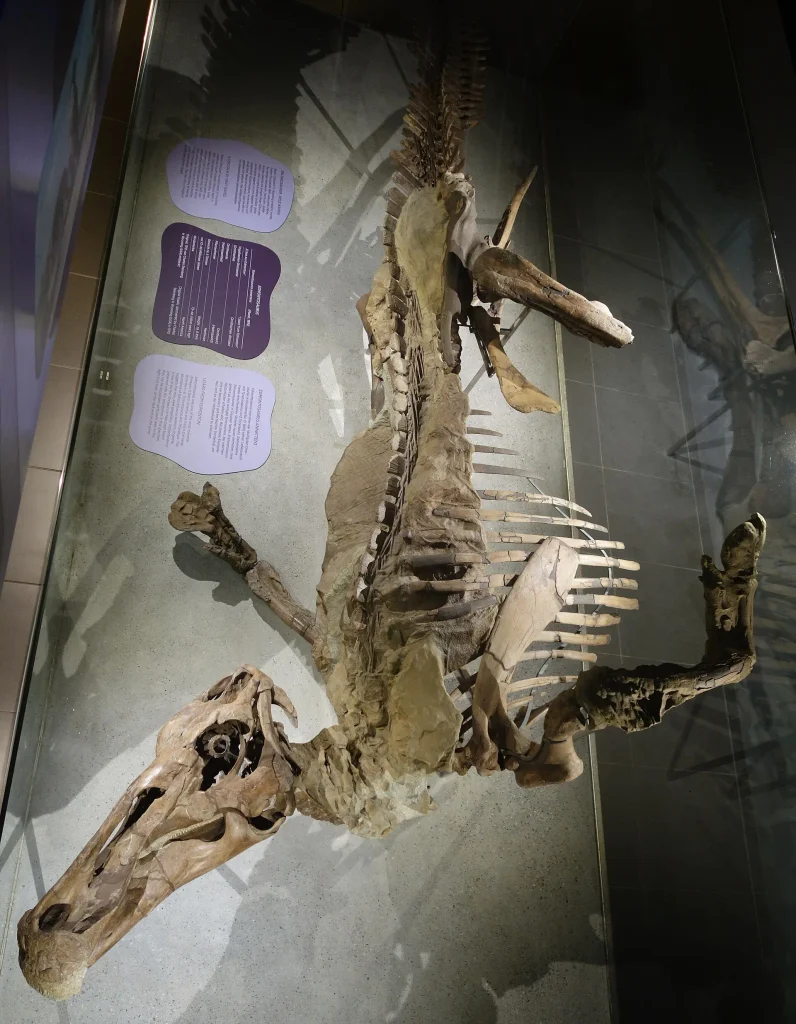
Few dinosaur fossils preserve more than bones. Even complete skeletons usually reveal only part of an extinct animal’s appearance because skin, muscles, beaks and other soft tissues normally disappear long before fossilization can occur. SMF R 4036, the famous Edmontosaurus mummy housed at the Senckenberg Natural History Museum in Frankfurt, Germany, is an extraordinary exception.
Often called the Senckenberg mummy and affectionately nicknamed “Edmond,” the specimen preserves a nearly complete skeleton together with remarkable evidence of the animal’s external body surface. It was discovered in Wyoming in 1910 in rocks of the Lance Formation, deposited near the end of the Cretaceous Period. The dinosaur lived roughly 66 million years ago, not long before the Cretaceous–Paleogene extinction event brought the age of non-avian dinosaurs to an end.
The specimen belongs to Edmontosaurus annectens, a large herbivorous member of the hadrosaur family, commonly known as the “duck-billed dinosaurs.” Its exceptional preservation has helped paleontologists study dinosaur skin, hands, feeding anatomy, posture, fossilization and even the environment in which Edmontosaurus lived.
Perhaps most fascinatingly, the fossil has repeatedly changed scientific thinking. Features once interpreted as swimming adaptations are now understood very differently, plant material once identified as stomach contents was probably carried into the carcass by water, and recent research has proposed a new explanation for how the dinosaur’s skin became preserved.
Quick Facts About the Senckenberg Mummy
| Feature | Details |
|---|---|
| Specimen number | SMF R 4036 |
| Nicknames | Senckenberg mummy, “Edmond” |
| Dinosaur | Edmontosaurus annectens |
| Family | Hadrosauridae |
| Diet | Herbivorous |
| Geological formation | Lance Formation |
| Geological age | Late Maastrichtian, Late Cretaceous |
| Approximate age | Around 66 million years |
| Discovery | September 1910 |
| Discovery location | Present-day Niobrara County, Wyoming, United States |
| Discoverers | Charles H. Sternberg and his fossil-hunting family |
| Museum | Senckenberg Natural History Museum, Frankfurt, Germany |
| Preservation | Nearly complete articulated skeleton with extensive external-body preservation |
| Scientific importance | Skin anatomy, hand structure, feeding anatomy, taphonomy and history of dinosaur reconstruction |
What Was Edmontosaurus?
Edmontosaurus was one of the largest and most widespread hadrosaurid dinosaurs of Late Cretaceous North America. Hadrosaurs were highly successful plant-eating dinosaurs equipped with broad snouts, complex dental batteries and powerful jaws capable of processing tough vegetation.
The Senckenberg mummy is assigned to Edmontosaurus annectens. Like other members of its genus, it had a long skull, a broad beak at the front of the jaws and hundreds of closely packed replacement teeth farther back in the mouth.
Calling Edmontosaurus a “duck-billed dinosaur” is convenient but somewhat misleading. Its snout was broader than that of many dinosaurs, yet its feeding apparatus was considerably more robust and complicated than a modern duck’s bill.
The animal could probably move on both two and four limbs depending on circumstances. Modern reconstructions generally show hadrosaurs carrying the trunk approximately horizontally, with the long muscular tail extended behind the body rather than dragging along the ground.
Why Is SMF R 4036 Called a Dinosaur Mummy?
The term dinosaur mummy does not mean that the animal was deliberately preserved in the manner of an Egyptian human mummy. In paleontology, the expression has traditionally been used for exceptionally preserved dinosaur specimens that retain extensive evidence of skin or other external tissues in association with the skeleton.
SMF R 4036 is particularly valuable because the skeleton remained largely articulated, meaning many bones stayed in their original anatomical relationships. Evidence of the body’s outer surface occurs around parts of the neck, trunk and forelimbs, with especially impressive preservation around the hand.
For much of the fossil’s scientific history, these features were simply described as skin impressions.
Research published in 2025 proposed a more complicated mechanism. Paul Sereno and colleagues argued that microbial biofilms developed over the carcass and attracted clay minerals. A very thin clay coating could therefore have reproduced the outer surface of the animal in positive relief after the original skin decomposed. Under this interpretation, some of what has traditionally been called an “impression” is better understood as a natural rendering or template of the skin surface.
This distinction is important because it shows that exceptional fossil preservation can record the form of soft tissue even when the original biological material itself has disappeared.
Discovery in Wyoming in 1910
The story of SMF R 4036 begins with one of the most famous fossil-hunting families in the history of North American paleontology.
Charles Hazelius Sternberg and his sons George, Charles Mortram and Levi worked extensively in the fossil-rich badlands of western North America. They excavated dinosaurs commercially and sold important specimens to museums in the United States, Canada and Europe.
The Sternbergs had already made a spectacular hadrosaur discovery in 1908. That earlier fossil, now known as AMNH 5060, was purchased by the American Museum of Natural History in New York and became one of the world’s first famous dinosaur mummies.
Only two years later, they discovered another extraordinary hadrosaur.
In early September 1910, while searching rocks of the Lance Formation in what was then Converse County and is now part of Niobrara County, Wyoming, Charles Mortram Sternberg noticed bones emerging from grey sandstone near southern Schneider Creek, now generally spelled Snyder Creek.
A sacral vertebra from the hip region and part of a hind limb were among the first visible remains.
Realizing that a major specimen might lie inside the rock, the family moved its camp to the locality. The excavation eventually proved to be one of the most difficult recovery operations the Sternbergs had attempted.
An Enormous Excavation Challenge
Preserving a normal dinosaur skeleton was difficult enough in the early twentieth century. Recovering a dinosaur with delicate external-body structures was far more demanding.
Charles H. Sternberg was determined to save as much of the fossilized skin evidence as possible. Rather than removing only individual bones, the team excavated enormous blocks of sandstone containing large portions of the dinosaur.
The block holding much of the trunk reportedly weighed more than 1,400 kilograms, while the complete shipment approached 4,500 kilograms.
The fossil hunters did not have modern cranes or hydraulic equipment. Large blocks had to be raised gradually using wooden levers while sand was repeatedly packed beneath them. Once sufficiently elevated, the blocks could be transferred onto a heavy wagon.
From the excavation site, the fossil had to travel roughly 121 kilometres to the railway station at Edgemont, South Dakota.
The entire excavation and transportation process required approximately two and a half months.
It was a remarkable logistical achievement for a field party working with horses, wagons, hand tools and wooden supports.
How the Fossil Reached Germany
After excavation, Charles H. Sternberg offered the specimen to paleontologist Fritz Drevermann, who headed the paleontology department of the Senckenberg Museum in Frankfurt.
The asking price was US$2,500, a considerable amount at the time. Funding was made possible through support from industrialist Arthur von Weinberg.
Interestingly, Sternberg reportedly received a later offer from the museum in Ottawa that was approximately twice as high. However, he had already committed himself to the Senckenberg Museum and honored the agreement.
The dinosaur therefore crossed the Atlantic and arrived in Frankfurt in 1911.
That decision ultimately gave Germany one of the most scientifically important hadrosaur fossils ever discovered.
Preparation of the Mummy
Preparing a fossil of this size and complexity was a huge undertaking.
Work began around 1912 after museum preparators completed other specimens that had arrived from Sternberg. Preparation continued for several years and was probably slowed considerably by World War I.
The work was finally completed around 1920.
SMF R 4036 also became associated with innovations in fossil preparation. Senckenberg preparators were among the early workers to employ compressed-air equipment for removing rock from large fossils, making the mummy part of the history not only of dinosaur research but also of paleontological laboratory technique.
Once exposed, the specimen attracted significant scientific attention.
Researchers investigated its skull, jaws, possible stomach contents, skin and unusual hand.
Some of their interpretations proved remarkably perceptive. Others would eventually become textbook examples of how scientific explanations change when new evidence appears.
Surviving World War II
The fossil experienced another dramatic chapter during World War II.
As Allied bombing threatened Frankfurt, museum workers constructed protective barriers around valuable specimens, including the Edmontosaurus mummy. When the danger increased, the fossil was eventually removed from the city for protection.
It survived the war itself.
However, an accident occurred during its return to the museum: the fossil reportedly fell from a truck and broke into several pieces.
Restoring such a complex specimen took more than a decade.
The mummy was eventually returned to exhibition, and in the 1960s a special display area was created so visitors could examine the fossil from multiple viewpoints.
Today, “Edmond” remains one of the best-known treasures of the Senckenberg collections. The specimen is documented by the museum collection and by photographic records showing its distinctive skull, articulated body and preserved external surfaces.
What Does the Skeleton Preserve?
SMF R 4036 is exceptionally complete.
One hind limb and the terminal portion of the tail are missing, but much of the remaining skeleton survives in articulation.
The skull is particularly impressive. It measures about 105 centimetres long and retains information rarely preserved in ordinary dinosaur fossils.
Evidence associated with the snout records the position and shape of the keratinous beak. Elements of the eye region, including the scleral ring, are also preserved.
Historical measurements reported the combined trunk and skull at approximately 3.7 metres, with around 1.7 metres of preserved tail. Because the very end of the tail is absent, these figures should not be treated as the complete living length of the dinosaur.
The individual was larger than the famous AMNH mummy and has been interpreted as a mature, probably old adult.
The Extraordinary Skin
The preserved external surface is one of the fossil’s greatest scientific assets.
Skin-related structures occur around the neck, side of the trunk and forelimbs.
Particularly detailed preservation occurs around the right hand.
Small polygonal scales can be observed on the palm. Historical descriptions report scales around 3–5 millimetres across in this region, while some scales on the upper surface of the hand are larger.
Such details provide an unusually direct glimpse of a dinosaur’s external covering.
Bones tell scientists about skeletal mechanics. Skin can reveal something different: how the body surface was organized, how digits were surrounded by flesh and how inaccurate skeletal reconstructions may be when soft tissues are ignored.
The Famous Mitten-Like Hand
Few features of the Senckenberg mummy have influenced dinosaur science as dramatically as its hands.
The fingers appear surrounded by a continuous, mitten-like covering of soft-tissue preservation.
Early researchers interpreted this tissue as webbing between the fingers.
That interpretation seemed logical in the context of early twentieth-century dinosaur science. Hadrosaurs had wide beaks and were frequently imagined as semi-aquatic animals resembling oversized reptilian ducks.
If their fingers were webbed, then perhaps their front limbs functioned like paddles.
The Senckenberg mummy and AMNH 5060 therefore appeared to provide powerful evidence that hadrosaurs spent much of their lives in lakes, rivers or swamps.
For decades, this aquatic interpretation dominated textbooks, museum displays and popular art.
Were Hadrosaurs Aquatic?
Modern paleontology no longer regards Edmontosaurus as a primarily aquatic dinosaur.
The shift began gradually.
In 1964, paleontologist John Ostrom argued that hadrosaur anatomy was better suited to feeding on resistant terrestrial vegetation and moving efficiently on land.
Later researchers reconsidered the supposedly webbed hands.
Robert Bakker argued in the 1980s that the preserved tissue was not swimming webbing at all. Instead, it represented a fleshy structure surrounding compact fingers. Drying and fossilization had distorted the tissue into something that earlier scientists interpreted as a paddle.
The short fingers were also poorly suited to producing broad swimming surfaces comparable to the webbed feet of modern aquatic birds.
Today, Edmontosaurus is reconstructed primarily as a terrestrial herbivore, although there is no reason to assume it could not enter water or swim when necessary.
The important lesson is that fossil evidence does not speak entirely for itself. Its interpretation depends on comparisons, anatomical knowledge and the scientific ideas available at a particular time.
Changing Ideas About Dinosaur Posture
Early reconstructions of hadrosaurs were also wrong about posture.
For much of the nineteenth and early twentieth centuries, large dinosaurs were often depicted with sprawling or semi-sprawling limbs, upright bodies and tails dragging along the ground.
Charles Sternberg himself once compared the mummy’s preserved limb position to the posture of a lizard.
Later biomechanical studies transformed this picture.
Dinosaurs are now understood to have carried their limbs beneath the body rather than sprawling sideways like many modern reptiles.
Hadrosaurs also held their trunks more horizontally than early reconstructions suggested, while the muscular tail extended behind them and normally remained above the ground.
Evidence from skeletons, trackways and functional anatomy collectively helped produce the modern image of Edmontosaurus as a much more active, efficient terrestrial animal than early twentieth-century artists imagined.
The Preserved Beak
Another exceptional feature of SMF R 4036 is evidence for the animal’s horny or keratinous beak.
Keratin rarely fossilizes. Consequently, skull bones alone do not always reveal the exact external outline of a dinosaur’s mouth.
The Senckenberg specimen shows that the beak extended beyond the underlying bone.
Its upper snout was wide, measuring roughly 33 centimetres across near the front.
The preserved upper beak projected below the margin of the bony upper jaw by approximately 8 centimetres according to historical studies.
The lower beak was not preserved in the same way and was probably narrower.
Together, the upper and lower beaks would have formed an efficient cropping apparatus for collecting vegetation.
This evidence also demonstrated why simply calling the animal’s mouth a “duck bill” can be misleading. The living beak was deep, robust and adapted to harvesting plants rather than functioning like the flattened filtering bill of a duck or spoonbill.
How Edmontosaurus Ate
Hadrosaurs possessed one of the most sophisticated feeding systems known among non-avian dinosaurs.
The front of the mouth lacked conventional cutting teeth and instead carried a keratinous beak. Plants were cropped with this structure before being moved toward the rear of the jaws.
Behind the beak were enormous dental batteries.
Instead of depending on a small row of permanent teeth, hadrosaurs continually produced replacement teeth arranged in densely packed columns. Numerous teeth could contribute to the grinding surface at any one time.
This system created durable surfaces capable of processing abrasive vegetation.
The Senckenberg skull became especially important in early investigations of how hadrosaur jaws moved.
Researcher Jan Versluys studied the angled tooth surfaces and asymmetric jaw joints during the 1920s. He proposed that hadrosaur chewing involved complicated movements rather than simple up-and-down biting.
Modern studies confirm the broader point: ornithopod dinosaurs developed highly sophisticated oral processing, though the exact mechanics of hadrosaur chewing have continued to be investigated and refined.
Their skulls allowed plant matter to be sliced and ground far more effectively than was once believed.
Was the Tongue Prehensile?
The fossil’s pronounced hyoid or tongue-supporting structures also inspired early speculation.
Versluys suggested that Edmontosaurus might have possessed a powerful, possibly prehensile tongue capable of helping gather vegetation, somewhat like the tongue of a giraffe.
That specific idea remains much less certain than the evidence for sophisticated chewing.
Soft-tissue reconstructions must be treated cautiously because a large hyoid does not automatically prove that the tongue could grasp plants.
Nevertheless, the observation illustrates how exceptional fossils can stimulate anatomical questions that ordinary skeletons rarely allow researchers to consider.
The Famous “Stomach Contents”
For decades, one of the most celebrated features of the Senckenberg mummy was a mass of plant material discovered within the body region.
After the fossil was prepared, paleobotanist Richard Kräusel examined the material.
It included fragments identified as conifer needles, pieces of branches and possible seeds or fruits.
Because the material occurred inside the carcass, Kräusel interpreted it as probable stomach contents.
This conclusion carried major scientific implications.
At the time, hadrosaurs were widely considered aquatic animals. Yet the supposed stomach contents consisted mainly of terrestrial vegetation.
If the plants really represented the dinosaur’s last meal, then Edmontosaurus must at least have fed extensively on land.
For decades, this became influential evidence in discussions of hadrosaur ecology.
Why the Stomach-Content Interpretation Changed
Not everyone accepted the stomach interpretation.
Even during early discussions, researchers suggested that plant debris might simply have been washed into the carcass after death.
The controversy became difficult to resolve because the original mass was removed and processed during early study.
A major reassessment was conducted by paleobotanist Dieter Uhl in 2020.
Using historic documentation, surviving microscope preparations and additional plant material from the surrounding sandstone, Uhl concluded that the supposed stomach contents were probably not genuine digestive remains.
Several observations supported this alternative.
The plant pieces were generally much smaller than material known from better-supported dinosaur gut contents and coprolites. They resembled water-transported plant debris found in surrounding sediment. Their position within the body cavity was also difficult to reconcile with normal stomach or intestinal anatomy.
A more plausible explanation is that sand entered the decomposing carcass during burial. A remaining cavity then acted like a trap in which small pieces of vegetation carried by water accumulated.
This interpretation does not mean Edmontosaurus was not herbivorous. Its teeth, jaws and entire digestive ecology overwhelmingly establish that it ate plants.
It simply means SMF R 4036 should no longer be cited confidently as preserving the dinosaur’s final meal.
How Did the Dinosaur Die?
The exact cause of death cannot be known with certainty.
Early interpretations focused on the unusual position of the skeleton. Because the carcass was found inclined within sandstone, with its head higher than part of the hindquarters, the Sternbergs proposed that the living dinosaur might have become trapped in soft sediment or quicksand and died while trying to escape.
That dramatic scenario was repeated for many years.
However, the available geology does not provide strong evidence proving a quicksand death.
Modern researchers instead focus on a sequence involving drought, dehydration, flooding and rapid burial.
A Modern Explanation for the Mummification
A detailed 2025 study proposed a new model for the formation of dinosaur mummies from the Lance Formation.
Under this hypothesis, the Senckenberg Edmontosaurus may have died in or near a river channel during a drought.
Dry conditions could have caused the carcass to dehydrate before complete decomposition.
A later flood may then have transported it a relatively short distance and buried it rapidly beneath sediment.
The entire interval between death and final burial may have occurred within a single season, possibly within only several weeks.
Sediment entering openings in the carcass could have filled the body cavity. This internal sand supported the external form of the dinosaur, helping prevent the body from collapsing completely.
Meanwhile, microorganisms colonized the skin.
A microbial biofilm developed around the carcass and interacted with extremely fine clay particles in the surrounding sediment. The minerals accumulated around the body, forming a coating less than a millimetre thick.
After the organic skin decayed, this mineral film retained a highly detailed replica of the original external surface.
This model helps explain why parts of SMF R 4036 preserve the shape of a three-dimensional body rather than appearing simply as flattened skin stains.
Why Rapid Burial Was Essential
Exceptional fossils require exceptional circumstances.
A large dead herbivore would normally be exposed to scavengers, insects, microorganisms, weathering and physical disarticulation.
Bones might become scattered. Skin would usually disappear rapidly.
SMF R 4036 escaped much of this destruction.
The articulated skeleton suggests that the body remained relatively intact before final burial. The preservation of delicate external structures likewise indicates that it was not transported violently over a great distance after the soft tissues had begun to decay.
Rapid sedimentation within a river-influenced environment therefore appears to have been crucial.
The Lance Formation
The Senckenberg mummy came from the Lance Formation, a major Late Cretaceous geological unit exposed in Wyoming.
The formation represents landscapes that existed very close to the end of the dinosaur era.
Rivers crossed broad floodplains, depositing sand and mud. Forests and wetlands supported complex plant communities, while dinosaurs and many smaller animals inhabited the region.
Edmontosaurus shared this ecosystem with some of the most famous dinosaurs ever discovered, including Triceratops and Tyrannosaurus rex.
The age of the upper Lance Formation approaches the Cretaceous–Paleogene boundary, meaning these animals lived only a relatively short geological time before the mass extinction approximately 66 million years ago.
The Wyoming “Mummy Zone”
One particularly intriguing aspect of recent research is that SMF R 4036 was not an isolated occurrence.
Several exceptionally preserved dinosaur specimens have been discovered within a surprisingly restricted area of Wyoming.
Researchers studying these fossils have referred to the locality as a “mummy zone.”
The area is only about 10 kilometres across, yet it has produced multiple Edmontosaurus mummies as well as unusually preserved remains associated with Triceratops and Tyrannosaurus.
The Senckenberg specimen appears to have been found approximately six kilometres northeast of AMNH 5060.
Researchers have suggested that rapid subsidence, high sedimentation rates and repeated cycles of drought followed by flooding may have made this particular region unusually favorable for mummy formation.
Instead of representing an inexplicable coincidence, the concentration of exceptionally preserved fossils may therefore reflect a specific combination of climate, geography and sedimentary processes.
What Was the Environment Like?
Microscopic fossils preserved in sediments associated with the specimen have helped scientists reconstruct its ancient environment.
A 2021 palynological investigation examined tiny plant remains recovered from rock samples taken from the body cavity.
Charcoal was especially abundant, suggesting that wildfires occurred regularly in the regional ecosystem.
Spores from ferns and mosses were common, while pollen showed that flowering plants and gymnosperms were also present.
The resulting picture is of a largely forested landscape.
Low-growing vegetation included ferns, mosses and flowering plants. Taller vegetation included conifers belonging to groups related to pine and cypress families, alongside cycads.
The regional climate appears to have been generally warm and humid, although the sedimentary evidence indicates that significant drought episodes could still occur.
This combination is important. A generally productive, humid ecosystem can nevertheless experience seasonal or episodic drought severe enough to kill large animals, after which floods may rapidly bury their remains.
Wildfires in the World of Edmontosaurus
The abundance of ancient charcoal adds another dimension to the reconstruction.
Late Cretaceous forests were not static, peaceful landscapes. Fire was an important ecological process.
Lightning or other natural ignition sources could burn vegetation, producing charcoal that was subsequently carried by rivers and buried within sediment.
Fire may have created open spaces, influenced plant succession and changed the distribution of available food.
Edmontosaurus therefore lived in a dynamic environment shaped by rivers, floods, vegetation growth, drought and wildfire.
The Second Famous Dinosaur Mummy
SMF R 4036 occupies an important place in paleontological history because it was the second major dinosaur mummy discovered.
The first famous example was the Edmontosaurus specimen AMNH 5060, discovered by the Sternberg family in 1908.
When the American Museum specimen was studied, paleontologist Henry Fairfield Osborn popularized the expression “dinosaur mummy.”
The Senckenberg specimen, found just two years later in the same general region, strengthened the realization that under rare conditions dinosaur skin and body form could leave extraordinarily detailed fossil traces.
Other remarkable mummified dinosaurs were discovered afterward, including Corythosaurus specimens from Canada.
More recently, famous examples such as the Brachylophosaurus nicknamed Leonardo and the Edmontosaurus known as Dakota have further expanded knowledge of dinosaur soft-tissue preservation.
A Dinosaur Mummy Lost at Sea
The history of dinosaur mummies even includes a wartime tragedy.
In 1916, another exceptionally preserved dinosaur collected by Sternberg was shipped toward Britain aboard the SS Mount Temple.
During World War I, the vessel was intercepted and sunk by a German surface raider.
The fossil cargo went to the bottom of the Atlantic.
As a result, an important dinosaur mummy and numerous other fossils were lost permanently.
The episode underscores how unusual it is that SMF R 4036 survived excavation, ocean transport, two world wars, a truck accident and more than a century of museum history.
Classification Through Time
The scientific name attached to the Senckenberg mummy has changed as dinosaur classification improved.
When the specimen was discovered, many North American duck-billed dinosaurs were grouped under the poorly defined genus Trachodon.
The mummy was therefore originally referred to as Trachodon annectens.
In 1942, Richard Swann Lull and Nelda Wright reassigned the species to Anatosaurus, producing the combination Anatosaurus annectens.
Later research showed that the species was more appropriately placed within Edmontosaurus.
By the late twentieth century, Edmontosaurus annectens became the generally accepted name.
These changes do not mean scientists repeatedly discovered that the fossil belonged to different animals. Rather, taxonomic revisions reflected improvements in understanding how known hadrosaur species were related to one another.
Why Hadrosaur Skin Is Preserved So Often
Hadrosaurs appear unusually frequently in the dinosaur skin-impression record.
One statistical analysis of Maastrichtian dinosaur fossils from North America found that skin preservation associated with hadrosaurs was dramatically more common than in other dinosaur groups from the same interval.
A substantial proportion of known hadrosaur skin records belong to Edmontosaurus.
Scientists still debate why.
Part of the explanation may involve abundance. Edmontosaurus was common, so more carcasses were available for fossilization.
Habitat may also have played a major role.
If Edmontosaurus commonly lived near river systems and coastal lowlands where sediment accumulated rapidly, its carcasses would have had a better chance of being buried quickly than dinosaurs that favored environments with slower sedimentation.
The Wyoming mummy zone provides an unusually striking example of this preservation bias.
What SMF R 4036 Changed About Dinosaur Science
The scientific importance of the Senckenberg mummy extends far beyond the fact that it looks impressive in a museum.
It demonstrates how paleontological interpretations evolve.
Its hand was once presented as evidence that hadrosaurs were aquatic. Today the same anatomy contributes to reconstructions of a fleshy terrestrial hand.
Its plant remains were once celebrated as fossil stomach contents. Modern taphonomic analysis indicates that they were probably washed into the carcass after death.
Its body position was once interpreted as evidence of a dinosaur struggling in quicksand. Recent research favors drought-related death followed by limited transport and flood burial.
Even the preserved “skin impressions” have been reinterpreted. A modern hypothesis suggests that clay attracted to microbial films created extraordinarily thin natural templates of the skin.
The specimen therefore records not only the biology of a dinosaur but also more than a century of changing scientific thought.
Why “Edmond” Is So Important Today
Ordinary dinosaur fossils answer basic questions about skeletal anatomy.
An exceptional specimen like SMF R 4036 can answer much more.
Its bones reveal the dimensions and structure of the animal. Its preserved beak helps reconstruct the true outline of the mouth. Its hands reveal the relationship between digits and surrounding soft tissues. Its external surfaces document scale patterns. Its articulation provides clues to burial. Sediment inside and around the carcass records the processes that acted after death. Pollen, spores and charcoal help reconstruct the ecosystem.
Few individual dinosaur specimens unite so many fields of study.
Anatomy, paleobotany, sedimentology, taphonomy, paleoecology and the history of science all intersect in this single fossil.
Historical Interpretations vs. Modern Understanding
The story of the Senckenberg mummy is particularly useful for showing how scientific knowledge changes when evidence is re-examined.
The broad hand did not prove that Edmontosaurus was a paddle-limbed aquatic dinosaur.
The material inside the body did not necessarily represent its final meal.
Its unusual pose does not establish that it died in quicksand.
And the structures traditionally described as simple skin impressions may represent a more complicated mineral replica formed through microbial and sedimentary processes.
Science advances precisely because old interpretations can be tested instead of being protected from revision.
SMF R 4036 has remained scientifically valuable because generations of researchers have been able to ask new questions of the same specimen.
Could Edmontosaurus Swim?
Rejecting the old aquatic-hadrosaur hypothesis does not mean Edmontosaurus was incapable of swimming.
Many large terrestrial animals can swim when necessary, including elephants, cattle and numerous other mammals.
A large hadrosaur entering deep water could probably have remained buoyant and propelled itself.
What modern evidence rejects is the stronger historical claim that its anatomy was primarily specialized for aquatic life and that its hands were dedicated paddles.
Its skeleton, feeding system and locomotor anatomy are much more consistent with an animal whose normal life took place on land.
What Did Edmontosaurus Eat?
Although the supposed stomach contents of SMF R 4036 are now doubtful, there is no serious uncertainty that Edmontosaurus was a plant eater.
Its broad cropping beak allowed it to collect vegetation efficiently.
Its massive dental batteries could shred and grind plant material.
Possible foods would have depended on what was locally available and may have included leaves, shoots, twigs, conifer material, flowering plants, ferns and other terrestrial vegetation.
Exactly how selective the animal was remains difficult to determine.
Different seasons and habitats may have provided different food sources, and the animal’s large body would have required substantial daily intake.
The Senckenberg Mummy and the End of the Dinosaur Age
One of the most evocative aspects of SMF R 4036 is its geological age.
This Edmontosaurus lived near the close of the Maastrichtian Age, only a relatively short geological interval before the asteroid impact and associated environmental catastrophes that contributed to the extinction of all non-avian dinosaurs.
Its ecosystem was therefore one of the final great dinosaur-dominated landscapes.
Edmontosaurus, Triceratops and Tyrannosaurus were not primitive dinosaurs approaching evolutionary failure. They were highly specialized animals living in rich ecosystems immediately before a sudden global crisis transformed life on Earth.
The Senckenberg mummy preserves an extraordinary physical record of that lost world.
Frequently Asked Questions
What is SMF R 4036?
SMF R 4036 is an exceptionally preserved specimen of Edmontosaurus annectens housed at the Senckenberg Natural History Museum in Frankfurt, Germany. It consists of a nearly complete skeleton associated with extensive preservation of the animal’s external body surface.
Why is it called the Senckenberg mummy?
It is named after the Senckenberg Museum, where the fossil has been housed since its arrival in Germany in 1911. “Dinosaur mummy” is an informal paleontological term for exceptionally preserved dinosaur fossils with extensive evidence of skin or other integument.
What is the dinosaur’s nickname?
The museum has nicknamed the specimen “Edmond.”
When was the dinosaur discovered?
It was discovered in September 1910 in Wyoming, United States.
Who discovered it?
The fossil was discovered during an expedition by the famous Sternberg family of fossil hunters, led by Charles Hazelius Sternberg and involving his sons.
How old is the fossil?
It comes from Late Maastrichtian rocks of the Lance Formation and is roughly 66 million years old.
What species is it?
It is assigned to Edmontosaurus annectens, a hadrosaurid or duck-billed dinosaur.
Is the original dinosaur skin still present?
Not necessarily. The fossil preserves extremely detailed evidence of the body’s outer surface, but modern research suggests that some of this preservation may consist of a microscopic clay template formed around microbial biofilms after burial rather than surviving original skin tissue.
Did Edmontosaurus have webbed hands?
Early paleontologists thought so. The mitten-like tissue around the fingers was once interpreted as swimming webbing. Today it is generally regarded as soft tissue surrounding a compact terrestrial hand rather than a specialized paddle.
Was Edmontosaurus an aquatic dinosaur?
No evidence supports the old idea that it was primarily aquatic. Modern reconstructions treat Edmontosaurus as a predominantly terrestrial herbivore, although it was probably physically capable of swimming when required.
Were stomach contents preserved?
Plant fragments were historically interpreted as stomach contents, but later analysis indicates that they were probably water-transported debris that entered the body cavity after death.
How might the mummy have formed?
Current research proposes that the dinosaur may have died during drought conditions, partially dried out and was subsequently transported a short distance by floodwater. Rapid burial filled the carcass with sediment, while microbial films and clay minerals helped preserve a remarkably detailed representation of the skin surface.
Final Thoughts
The Edmontosaurus mummy SMF R 4036 is far more than an unusually complete dinosaur skeleton. It is a rare three-dimensional record of an animal that lived near the end of the Cretaceous Period and one of the most important fossils for understanding how hadrosaurs actually looked.
Discovered in Wyoming in 1910 and transported across the Atlantic to Frankfurt, the specimen has survived war, relocation, accidental breakage and more than a century of scientific investigation.
Its preserved hand once convinced researchers that hadrosaurs were aquatic. Its plant debris was once treated as a fossilized meal. Its pose inspired theories of death in quicksand. Each interpretation seemed reasonable in its own era, yet each could be reconsidered as paleontology developed better anatomical, geological and taphonomic methods.
Modern research paints an even more fascinating picture. “Edmond” was probably a large terrestrial herbivore living in a warm Late Cretaceous landscape of forests, rivers, flowering plants, conifers, ferns, periodic wildfires and climatic fluctuations. Its carcass may have dried during a drought before being rapidly buried by flood-derived sediment. Microbial films and microscopic clay particles then helped record its body surface with extraordinary precision.
About 66 million years later, that combination of biological and geological circumstances allows us to examine details that normally disappear within days of an animal’s death.
That is what makes the Senckenberg mummy extraordinary. SMF R 4036 does not merely preserve the bones of an Edmontosaurus; it provides one of the closest fossil approximations we have to seeing the shape and surface of a large dinosaur as it existed in life.