
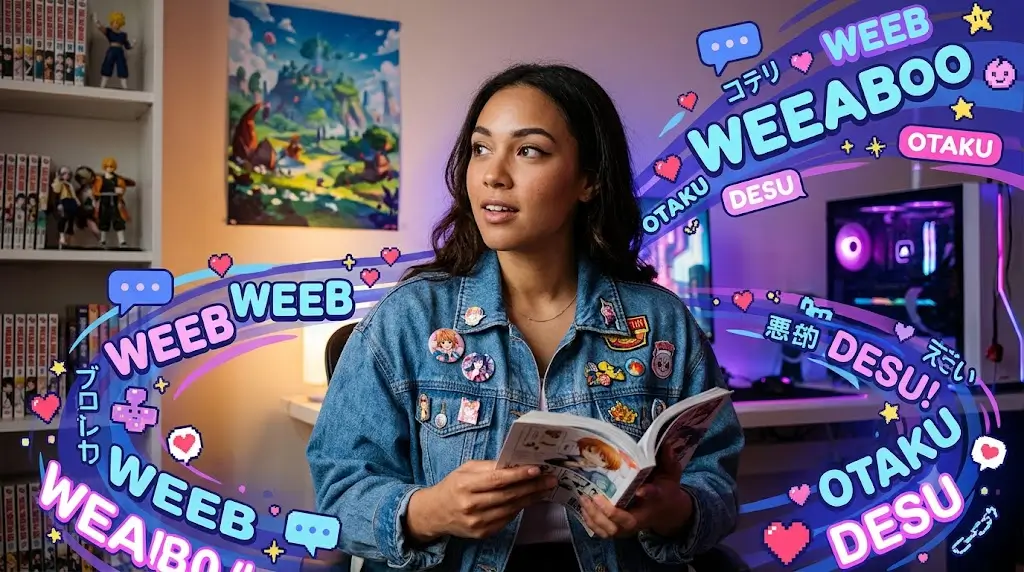
wee·a·boo | /ˈwiː.ə.buː/
noun, plural wee·a·boos
slang, internet culture, often derogatory, sometimes humorous or self-deprecating
variant: weeb
Lexical Definition
- A non-Japanese person—predominantly from the West—who demonstrates an obsessive fixation on Japanese popular culture (especially anime, manga, and video games) to the extent of idealizing or fetishizing Japan, often while scorning their own heritage.
- (Sociolinguistic extension, loose usage) An avid, enthusiastic consumer of anime or related subcultures, used ironically or as an in-group badge of identity.
Etymology & Cultural Origin
The term emerged through an internet moderation maneuver rather than organic linguistic drift.
In the early to mid-2000s, internet forums—most notably the imageboard 4chan—frequently used the derogatory portmanteau Wapanese (a blend of “white” or “wannabe” and “Japanese”) to mock non-Japanese users who displayed performative, superficial obsessions with Japan. In mid-2005, the site administrator implemented a global word filter that automatically replaced every instance of Wapanese with the nonsense word weeaboo.
The word originated from Nicholas Gurewitch’s surreal webcomic strip The Perry Bible Fellowship, where “weeaboo” had zero semantic connection to Japan; in the comic, it was simply a nonsensical sound that prompted characters to beat whoever uttered it. The forum filter backfired semantically: instead of curbing hostility, users absorbed the replacement word, turning weeaboo into the definitive internet epithet for obsessive Japanophiles.
Core Behavioral Archetype
In subcultural discourse, the classical “weeaboo” is characterized by several recurring traits:
- Linguistic code-mixing: Inserting ungrammatical, out-of-context Japanese vocabulary into everyday English sentences (e.g., using kawaii, desu, sugoi, or arigato).
- Cultural projection: Treating anime tropes and dramatic conventions as realistic reflections of everyday Japanese society, civic customs, and interpersonal dynamics.
- Superiority fallacy: Declaring Japanese commodities, culinary traditions, artistic output, and social norms inherently superior to domestic culture.
- Exoticization: Reducing a multifaceted sovereign nation and history into an aesthetic playground of sword fighting, convenience store snacks, and school uniforms.
Semantic Evolution: From Weeaboo to Weeb
Over two decades, the term underwent notable semantic bleaching and reclamation:
[ Mid-2000s ]         [ Early 2010s ]                 [ Modern Era ]
  "Wapanese"    ──►   "Weeaboo" (Full Slur)     ──►   "Weeb" (Reclaimed Slur)
(Hostile insult)     (Harsh internet mockery)         (Playful, casual, ironic)
During the 2010s, the clipped form weeb became dominant. As mainstream audiences adopted anime via major streaming platforms like Crunchyroll and Netflix, the intensity of the term softened. Today, anime fans frequently label themselves “weebs” in self-deprecating humor (e.g., “I’m spending my entire weekend binge-watching like a total weeb”), whereas the full three-syllable weeaboo often preserves the sharper, more critical stigma of excessive, socially unaware obsession.
Weeaboo vs. Otaku vs. Koreaboo
| Term | Linguistic Origin | Scope of Fixation | Primary Connotation |
| Weeaboo | English web slang (2005) | Non-Japanese person fixated specifically on Japanese pop culture | Pejorative; implies delusion, superficiality, and outsider cringe |
| Otaku | Native Japanese (おたく) | Extreme devotion to any specific hobby (trains, idols, manga, military) | Geeks/nerds; neutral-to-proud in the West, historically stigmatized in Japan |
| Koreaboo | Analogous English slang (c. 2010s) | Non-Korean person obsessed with K-pop, K-dramas, and Korean culture | Pejorative; carries the same fetishization critique as weeaboo |
Lexical Usage Examples
- As an external critique:
“He visited Kyoto expecting people to talk like characters in a battle shōnen, proving he was completely stuck in his weeaboo fantasy.” - As self-deprecating in-group banter:
“Don’t judge my shelf full of scale figures—my inner weeb made that financial decision.” - Adjectival form (weeabooish / weeby):
“The restaurant’s neon aesthetic was deliberately weeby, leaning heavily into vintage 90s cyber-anime nostalgia.”