
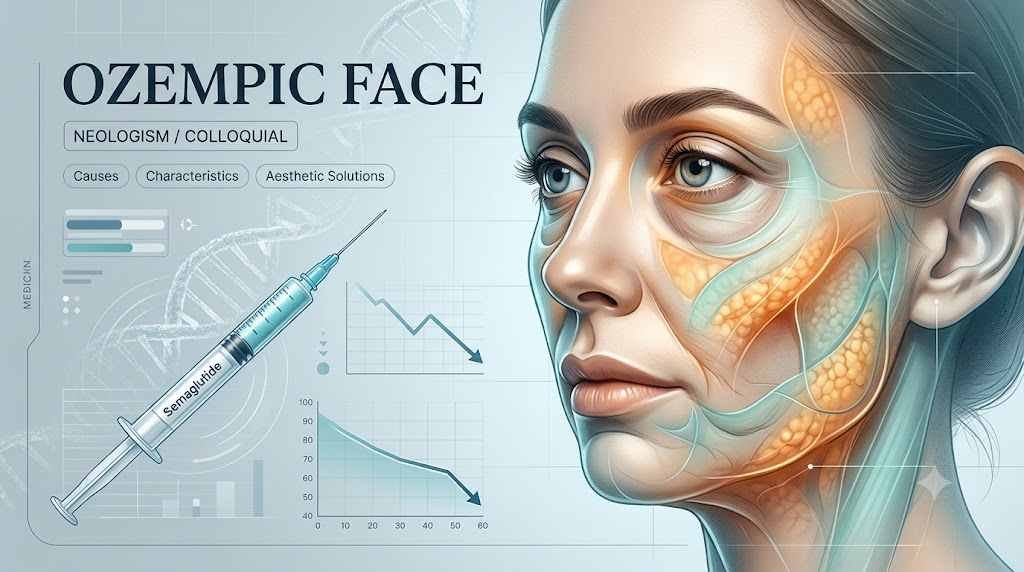
Ozempic Face
Pronunciation: /oʊˈzɛm.pɪk feɪs/
Part of Speech: Noun phrase, colloquial, neologism / pop-culture slang
Field Labels: Pop Culture, Aesthetic Medicine, Digital Trend, Dermatology (informal)
Lexical Definition
Ozempic face refers to a gaunt, hollowed-out, or prematurely aged facial appearance resulting from rapid, significant loss of facial fat (subcutaneous adipose tissue) and skin elasticity. It is characteristically observed in individuals undergoing substantial weight reduction through GLP-1 receptor agonist medications such as semaglutide (marketed under brand names including Ozempic and Wegovy) or tirzepatide.
Clinical Note: The phrase is not an official medical diagnostic term. In clinical dermatology and plastic surgery, the phenomenon is classified as a variant of generalized or secondary facial lipoatrophy and cutis laxa induced by acute negative energy balance.
Etymology and Cultural Origin
- Origin of Name: A portmanteau uniting Ozempic (the brand name for semaglutide, approved primarily for type 2 diabetes management) with face.
- Coinage: The term gained massive public traction in late 2022 and early 2023, widely credited to New York dermatologist Dr. Paul Jarrod Frank in media appearances after a surge of patients presented with rapid volume depletion in the midface following off-label semaglutide use for weight loss.
- Cultural Spread: Amplified via TikTok, Reddit, tabloids, and celebrity red carpet gossip, the phrase rapidly transformed from a clinical observation into social media slang, joining related internet coinages such as Ozempic butt, GLP-1 body, and buccal fat craze.
Key Signs and Characteristics
When subcutaneous fat reserves diminish faster than the dermis can naturally remodel, distinct architectural changes occur in the facial envelope:
- Midface Hollowing: Significant deflation of the malar fat pads, producing sunken cheeks and flattened cheek contours.
- Temporal and Periorbital Wasting: Loss of temple fullness and hollowed-out orbital rims, creating a skeletal or fatigued look.
- Exaggerated Folds: Deepening of nasolabial folds (smile lines) and marionette grooves due to downward tissue descent.
- Lower Face Laxity: Loss of jawline crispness, resulting in skin sagging, early jowling, and loose skin around the submental (neck) region.
- Texture Alterations: Accentuation of fine lines and crepey skin texture caused by reduced collagen and elastin tension.
Physiological Mechanics: What Actually Causes It?
The drug molecule itself does not target or dissolve facial fat specifically. Rather, the appearance stems from basic human anatomy under conditions of accelerated weight loss:
- Uniform Adipose Depletion: Systemic lipolysis burns fat indiscriminately. Facial fat pads—which provide structural scaffolding and youthful skin projection—shrink proportionally with abdominal and visceral stores.
- Deflation Without Retraction: In gradual weight loss (e.g., 0.5 to 1 kg per week), dermal fibroblast activity and skin elasticity have time to slowly accommodate changing volumes. GLP-1 medications can trigger rapid weight drops, leaving the cutaneous layer unsupported, much like an overstretched balloon that has been quickly deflated.
- Age and Sun Damage Compounding: Individuals over the age of 35 to 40 naturally possess lower baseline collagen turnover and elastin reserves. When dramatic fat loss occurs in mature skin, retraction is severely impaired.
Societal and Cultural Impact
| Dimension | Cultural Manifestation |
|---|---|
| Social Stigma vs. Status Symbol | Once hidden, having “Ozempic face” shifted into a dual signifier—critiqued by some as an indicator of shortcut vanity, while treated by others as an elite aesthetic marker of luxury wellness access. |
| Aesthetic Industry Boom | Sparked a massive surge in non-surgical volumizing procedures, nicknamed “Ozempic repair kits” (dermal fillers, biostimulatory injectables, microfocused ultrasound). |
| Shifting Beauty Ideals | Clashed directly with the 2010s “Instagram face” aesthetic of pillowy, high-volume cheekbones and full lips, pulling the aesthetic conversation toward angular, sculpted, and sometimes hyper-lean features. |
Usage in Discourse
In Everyday Slang and Media
- “Did you see him at the premiere? The jawline is sharp, but the hollow cheeks are giving full Ozempic face.”
- “I hit my target weight on Wegovy, but now I’m dealing with the dreaded Ozempic face—my foundation doesn’t even sit the same.”
Derived and Related Lexicon
- Ozempic Body: Loose skin and diminished gluteal volume following semaglutide-induced mass reduction.
- Buccal Fat Removal: A cosmetic surgery that excises the buccal fat pad, often compared visually to the hollowed cheeks of rapid weight loss.
- Volume Restoration: Aesthetic terminology for countering facial volume loss via exogenous substances.
Clinical Management and Preventative Strategies
- Slowing Rate of Loss: Titrating medication dosages under physician guidance to prioritize steady, gradual mass reduction rather than aggressive drops.
- Nutritional Optimization: Emphasizing sufficient dietary protein and micronutrients (e.g., Vitamin C, Zinc) alongside resistance training to preserve lean body mass and support connective tissue synthesis.
- Non-Surgical Aesthetics: Dermatological interventions using hyaluronic acid fillers, poly-L-lactic acid (PLLA), calcium hydroxylapatite, or autologous fat transfer to re-establish midface projection.
- Surgical Options: Rhytidectomy (facelift) or neck lift procedures for individuals with substantial redundant skin folds following massive weight loss.