
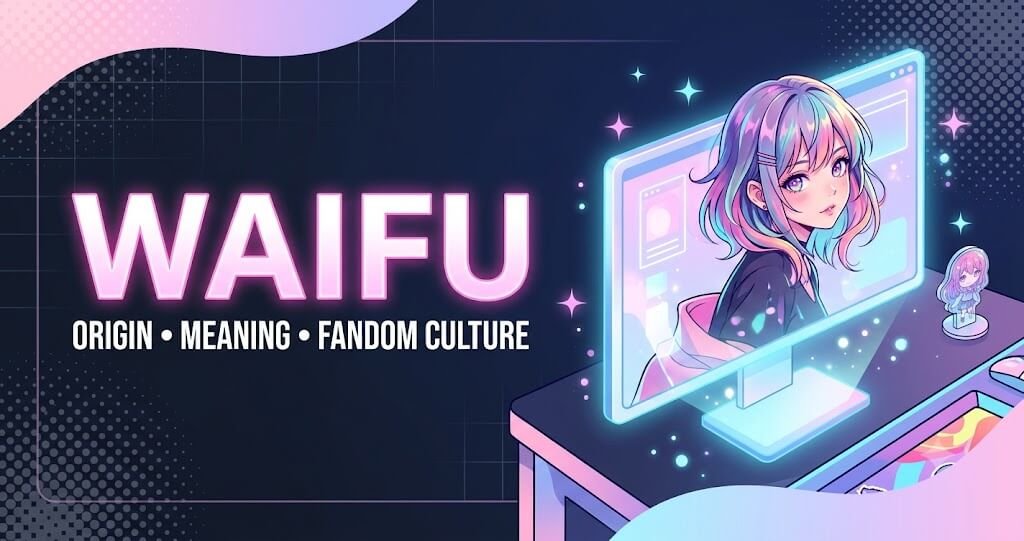
Waifu
(noun / pop-culture slang)
Pronunciation: /ˈwaɪ.fuː/ (WYE-foo)
Plural: waifus
Related Forms: waifuism (noun), waifuing (verb), non-waifu (adjective)
Antonyms / Counterparts: Husbando (male counterpart), Trash-tier (derogatory)
Lexical Definition
- Pop Culture & Fandom: An anime, manga, light novel, or video game fictional character (predominantly female) toward whom an individual feels a strong sense of romantic affection, deep emotional attachment, aesthetic admiration, or loyalty.
- Extended Internet Slang: Any fictional entity, persona, or stylized pop-culture figure regarded as an idealized partner or ultimate personal favorite.
Etymology and Linguistic Journey
The term waifu represents a fascinating phenomenon in cross-cultural linguistic exchange:
- English Roots to Japanese Loanword: The English noun wife entered modern Japanese parlance as the loanword (gairaigo) ワイフ (waifu). In post-war Japan, Western loanwords were frequently incorporated into vernacular speech. While standard Japanese uses native terms such as tsuma (妻) or kanai (家内) for one’s spouse, waifu emerged with a slightly Westernized, stylized nuance.
- The Catalyzing Origin (Azumanga Daioh, 2002): The subcultural adoption traces specifically to Episode 15 of the comedic slice-of-life anime Azumanga Daioh. In the scene, the eccentric teacher Mr. Kimura drops a photograph of a beautiful woman. When his students inquire about her identity, he proudly replies in broken English: “My wife.” To English-speaking audiences watching fan-subtitled releases, the phonetic Japanese rendering sounded distinctly like “Mai waifu.”
- Adoption and Re-Export: Western anime communities on early imageboards and forums (notably 2channel, 4chan’s /a/ board, and Reddit) picked up the phrase in the mid-2000s. It underwent semantic narrowing, moving away from denoting an actual human spouse to exclusively signifying a 2D romantic ideal. By the 2010s, the term re-entered mainstream global English slang.
Cultural Context & Fandom Dynamics
Within contemporary digital and otaku culture, the concept of a waifu carries unwritten social codes, etiquette, and variations:
1. The “One True Waifu” Doctrine (Monogamy vs. Polygamy)
Traditional anime purists adhere to the adage: “Having more than one waifu will ruin your laifu.”
- The Monogamous Camp: Believes devotion should be pledged exclusively to a single character. Switching favorites frequently is socially penalized as being fickle or insincere.
- Seasonal Waifus: A modern, casual shift where fans adopt a new favorite character with each quarterly broadcast season (Winter, Spring, Summer, Fall), reflecting the rapid consumption cycles of streaming media.
2. Husbando Counterpart
As fandom demographics diversified, the linguistic twin husbando (/ˈhʌz.bæn.doʊ/, derived from husband) emerged to refer to male fictional characters held in identical romantic esteem.
3. Commercialization and Merchandising
The waifu archetype drives massive global industries, encompassing:
- Dakimakura: Long body pillows featuring life-sized character prints.
- Gacha Games: Mobile gaming models (such as Genshin Impact, Fate/Grand Order, and Azur Lane) intentionally designed around character acquisition mechanisms commonly referred to as “waifu collection.”
- Scale Figurines & Acrylic Stands: Tangible display items that serve as physical anchors for fictional affection.
Usage in Sentences
- Subcultural/Enthusiast: “I skipped pulling on the meta banners this month because I’m saving all my in-game currency for my waifu.”
- Casual/Humorous: “Don’t insult her design; that’s literally his top-tier waifu since 2016.”
- Analytical/Industry: “The game’s monetization relies less on competitive balance and more on high-fidelity waifu marketing.”
Key Associated Terminology
| Term | Meaning |
| Husbando | The male fictional equivalent of a waifu. |
| Best Girl | A broader, often community-debated title for the highest-quality female character in a specific series, independent of romantic attachment. |
| Dakimakura | A body pillow commonly printed with illustrations of waifus or husbandos. |
| 2D vs. 3D | The contrast drawn between two-dimensional fictional media and three-dimensional physical reality. |
| Itabag | A tote bag adorned extensively with badges, keychains, and pins dedicated to a specific character. |