

Uttar Pradesh Legislative Council Election 2026: Counting Underway for 11 Key Seats
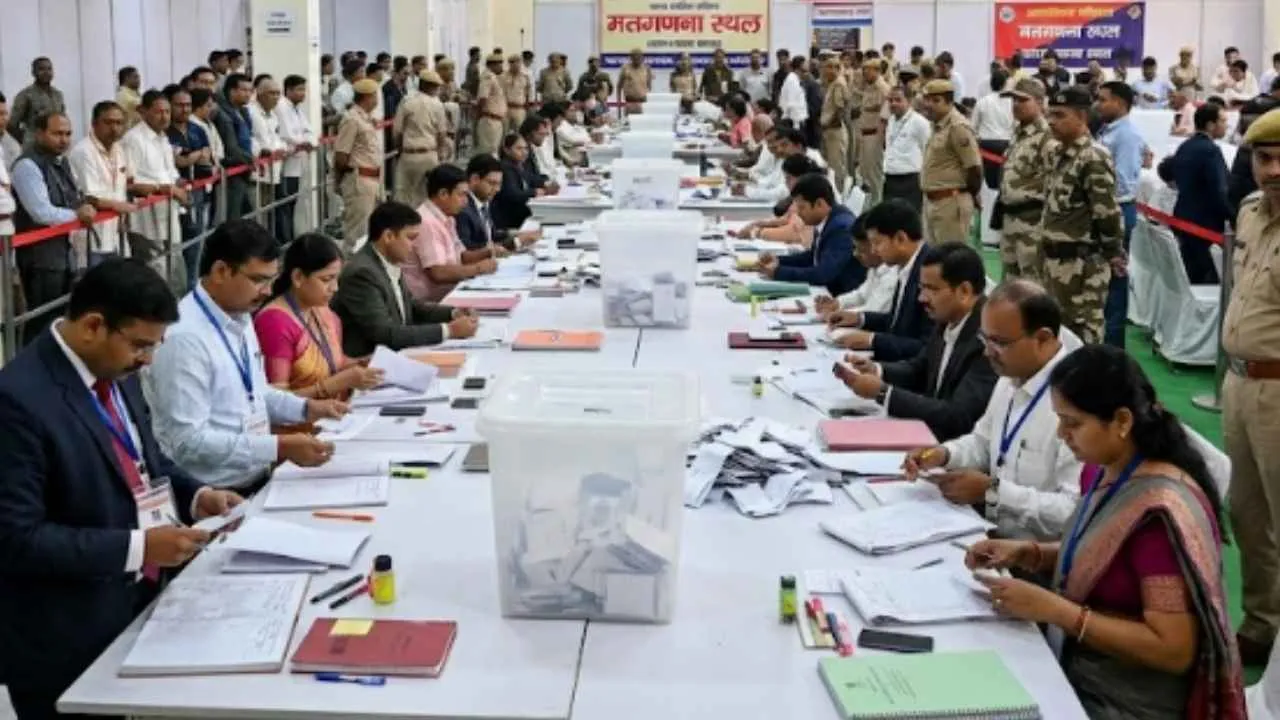
The electoral arena in Uttar Pradesh has intensified as vote counting commenced at 8:00 AM on Tuesday, October 27, 2026, across designated high-security centres. The exercise will decide the fate of 11 critical Uttar Pradesh Legislative Council (Vidhan Parishad) seats, comprising five Graduates’ and six Teachers’ constituencies.
With 152 candidates in the fray and polling concluding across 72 districts, the contest is widely viewed as a crucial litmus test and semi-final clash between Chief Minister Yogi Adityanath’s ruling Bharatiya Janata Party (BJP) and Akhilesh Yadav’s Samajwadi Party (SP) ahead of the pivotal 2027 UP Assembly elections.
Polling Overview and Voter Turnout
Voting for these 11 biennial seats concluded earlier across 2,697 polling stations.
- Total Electors: 14,81,310 registered graduates and educators exercised their democratic franchise.
- Overall Voter Turnout: Recorded at 55.24%.
- Geographical Coverage: 72 administrative districts participated, excluding Kanpur Nagar, Kanpur Dehat, and Unnao.
- Contestants: 152 candidates representing various political parties, teachers’ unions, and independent platforms.
Counting Centres and Security Arrangements
Due to the use of physical ballot papers and preferential ranking, the tallying process is meticulous, requiring initial bundling of ballots into groups of 50 before round-wise evaluation begins. To maintain transparency, the Election Commission has deployed multi-tier security cordons, round-the-clock CCTV surveillance, and designated observer teams at seven primary regional counting hubs:
- Lucknow: Ramabai Ambedkar Rally Ground (monitoring Lucknow Division seats across 14 tables per segment).
- Gorakhpur: Pandit Deendayal Upadhyay Gorakhpur University (handling the Gorakhpur-Faizabad division).
- Varanasi: Pahariya Mandi (operating across 15 counting tables).
- Agra: Navin Galla Mandi.
- Meerut: Sardar Vallabhbhai Patel University of Agriculture and Technology.
- Bareilly: Regional mandi premises for Bareilly-Moradabad constituencies.
- Jhansi: Designated administrative counting hall for the Allahabad-Jhansi division.
Constituency-Wise Lineup and Counting Status
The 11 constituencies showcase neck-and-neck battles across western UP, Awadh, Bundelkhand, and Purvanchal:
| Constituency Type | Constituency | Key Contenders / Current Status |
| Graduates | Lucknow Division | Awanish Kumar Singh (BJP) vs. Sushil Kumar (SP) |
| Graduates | Varanasi Division | Ashutosh Sinha (SP) vs. Kedar Nath Singh (BJP) |
| Graduates | Agra Division | Hari Kishore Tiwari (BJP) vs. Shashank (SP) |
| Graduates | Meerut Division | Pramendra Singh (SP) vs. BJP nominee |
| Graduates | Allahabad-Jhansi Division | Dr. Man Singh Yadav (SP) vs. Ashok Kumar Rathore (BJP) |
| Teachers | Lucknow Division | Ballot sorting and bundling in progress at Ramabai Rally Ground |
| Teachers | Varanasi Division | Pramod Mishra (BJP) vs. Lal Bihari Yadav (SP); 15 tables active |
| Teachers | Agra Division | Counting underway at Navin Galla Mandi |
| Teachers | Meerut Division | Early rounds progressing following completion of ballot bundling |
| Teachers | Bareilly-Moradabad | Hari Singh Dhillon (BJP) vs. Haji Danish Akhtar (SP) |
| Teachers | Gorakhpur-Faizabad | Dr. Sanjayan Tripathi (SP) vs. BJP nominee; ballot verification underway |
Understanding the Winning Criteria: Proportional Representation via STV
Unlike single-member legislative assembly elections governed by the first-past-the-post rule, MLC elections for graduates’ and teachers’ seats operate under the Single Transferable Vote (STV) system with proportional representation.
                Total Valid Votes
Winning Quota = ----------------- + 1
                 (Seats to Fill + 1)
- Sorting and Bundling: Ballot boxes are opened before candidate representatives, and ballot papers are bundled into lots of 50 to confirm total votes cast.
- First-Preference Count: Only the first-preference votes (“1”) marked on valid ballot papers are tabulated initially.
- Reaching the Quota: If a candidate crosses the predetermined minimum quota on the first-preference count alone, they are immediately declared elected.
- Elimination and Transfer Rounds: If no candidate reaches the quota outright, the lowest-polling candidate is eliminated. Their ballots are reviewed, and second-preference votes (“2”) are redistributed to the remaining active contenders.
- Successive Threshold Resolution: The elimination and value transfer cycle repeats sequentially until a candidate secures the threshold or remains as the sole surviving contestant. This manual re-tabulation is why MLC results typically take well into the late evening or early hours of the following morning to conclude.
Differences Between Vidhan Parishad and Vidhan Sabha Polls
| Dimension | Legislative Council (MLC – Graduates/Teachers) | Legislative Assembly (MLA) |
| Electorate | Restricted to eligible degree-holders (graduates) and accredited school/college teachers. | Universal adult franchise; all registered citizens aged 18 and older. |
| Voting Method | Paper ballot marked with preference numerals (1, 2, 3…). | Electronic Voting Machines (EVM) with VVPAT slips. |
| Electoral System | Proportional Representation by Single Transferable Vote (STV). | First-Past-The-Post (FPTP) system. |
| Counting Speed | Requires extensive time due to manual bundling, quota calculation, and vote transfers. | Rapid tallying via electronic machine readers, completed within hours. |
Political Significance: The 2027 Assembly Semi-Final
While the Legislative Council is a continuing chamber (Upper House), the outcome of these 11 seats carries significant political weight across Uttar Pradesh:
- Mood of the Intelligentsia: Graduates and educators serve as an intellectual barometer across both urban and rural belts. Their choices offer early signals on issues such as government employment, public recruitment exams, teacher regularisation, and Old Pension Scheme (OPS) demands.
- BJP’s Mission 2027: Having held six of the 11 outgoing seats, the BJP aims to demonstrate that its governance model retains solid support among middle-class, educated segments across eastern, central, and western UP.
- SP’s PDA Strategy Test: For Akhilesh Yadav’s Samajwadi Party, which held three outgoing seats, these elections test the traction of their broader socio-political coalitions outside conventional rural strongholds. A strong showing would provide considerable organizational momentum heading into the 2027 assembly campaign.