

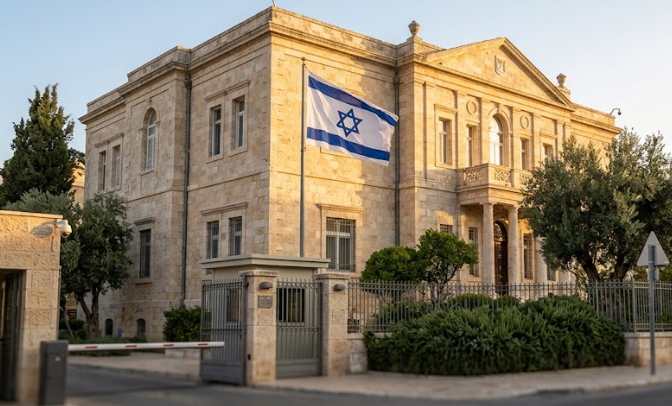
The Office of the Prime Minister of Israel
Israel functions under a parliamentary democracy where executive authority is vested in the Prime Minister, who serves as the head of government and chief decision-maker. While the President of Israel holds the ceremonial and constitutional role of head of state, the Prime Minister drives national policy, oversees national defense and security, directs the cabinet, and manages domestic and foreign affairs.
The official residence and working headquarters of the Prime Minister is Beit Aghion, situated in the Rehavia neighborhood of Jerusalem.
How the Prime Minister is Chosen
Unlike presidential systems where voters directly choose their chief executive, Israeli citizens vote for political party lists to fill the 120 seats of the Knesset, Israel’s unicameral parliament:
- Consultation: Following parliamentary elections, the President of Israel holds formal consultations with the leaders of all elected factions.
- Mandate: The President assigns the task of forming a government to the Knesset member considered to have the best prospect of securing a majority.
- Coalition Building: The designated candidate receives an initial window of 28 days (with the possibility of an extension) to assemble a viable coalition.
- Vote of Confidence: Once an agreement is reached, the proposed cabinet and policy platform are presented to the Knesset. A simple majority vote of confidence formally inaugurates the Prime Minister and their government.
Current Leadership: Benjamin Netanyahu
Benjamin Netanyahu, leader of the center-right Likud party, is the longest-serving Prime Minister in modern Israeli history. His tenure spans three distinct eras:
- First Term (1996–1999): Elected during the direct election system era, becoming Israel’s youngest Prime Minister and the first born after the establishment of the state.
- Second Era (2009–2021): A continuous 12-year stretch marked by substantial domestic economic growth, normalization agreements known as the Abraham Accords, and firm security stances against regional adversaries.
- Third Era (December 2022–Present): Returning to office at the helm of a right-wing and religious coalition.
Chronological List of Israel’s Prime Ministers (1948–2026)
Fourteen individuals have been officially sworn in as Prime Minister since 1948, along with one interim leader (Yigal Allon) who served temporarily following Levi Eshkol’s passing.
| Prime Minister | Political Party | Term of Office | Key Historical Context |
| David Ben-Gurion (1st term) | Mapai | May 14, 1948 – Jan 26, 1954 | Founding father; read the Declaration of Independence. |
| Moshe Sharett | Mapai | Jan 26, 1954 – Nov 3, 1955 | Diplomat; led foundational international foreign relations. |
| David Ben-Gurion (2nd term) | Mapai | Nov 3, 1955 – June 26, 1963 | Oversaw the 1956 Sinai Campaign and national development. |
| Levi Eshkol | Mapai / Alignment | June 26, 1963 – Feb 26, 1969 | Led during the 1967 Six-Day War; died in office. |
| Yigal Allon (Acting) | Alignment / Labour | Feb 26, 1969 – Mar 17, 1969 | Military commander; served as caretaker interim PM. |
| Golda Meir | Alignment / Labour | Mar 17, 1969 – June 3, 1974 | Israel’s first and only female Prime Minister; led in 1973 Yom Kippur War. |
| Yitzhak Rabin (1st term) | Alignment / Labour | June 3, 1974 – June 20, 1977 | Former IDF Chief of Staff; authorized Operation Entebbe. |
| Menachem Begin | Likud | June 20, 1977 – Oct 10, 1983 | First right-wing leader; signed 1979 Egypt–Israel peace treaty. |
| Yitzhak Shamir (1st term) | Likud | Oct 10, 1983 – Sept 13, 1984 | Former underground leader; guided the nation through economic crisis. |
| Shimon Peres (1st term) | Alignment / Labour | Sept 13, 1984 – Oct 20, 1986 | Led National Unity Government under a rotation agreement. |
| Yitzhak Shamir (2nd term) | Likud | Oct 20, 1986 – July 13, 1992 | Oversaw mass immigration from the Soviet Union and Gulf War defense. |
| Yitzhak Rabin (2nd term) | Labour | July 13, 1992 – Nov 4, 1995 | Signed Oslo Accords and Jordan Peace Treaty; assassinated in 1995. |
| Shimon Peres (2nd term) | Labour | Nov 4, 1995 – June 18, 1996 | Assumed office following Rabin’s assassination; later became President. |
| Benjamin Netanyahu (1st term) | Likud | June 18, 1996 – July 6, 1999 | First Prime Minister elected directly by nationwide ballot. |
| Ehud Barak | One Israel / Labour | July 6, 1999 – Mar 7, 2001 | Highly decorated soldier; oversaw IDF withdrawal from southern Lebanon. |
| Ariel Sharon | Likud / Kadima | Mar 7, 2001 – Apr 14, 2006 | Executed the 2005 Gaza Disengagement; founded the centrist Kadima. |
| Ehud Olmert | Kadima | Apr 14, 2006 – Mar 31, 2009 | Led during the 2006 Second Lebanon War and Annapolis peace summit. |
| Benjamin Netanyahu (2nd term) | Likud | Mar 31, 2009 – June 13, 2021 | Brokered Abraham Accords with UAE, Bahrain, Sudan, and Morocco. |
| Naftali Bennett | Yamina | June 13, 2021 – July 1, 2022 | Led a historic multi-faction unity government under a rotation accord. |
| Yair Lapid | Yesh Atid | July 1, 2022 – Dec 29, 2022 | Succeeded Bennett as caretaker PM; signed maritime boundary deal with Lebanon. |
| Benjamin Netanyahu (3rd term) | Likud | Dec 29, 2022 – Present | Current incumbent head of government. |
Notable Highlights & Historical Facts
- The Tally: Counting substantive appointments, 14 different individuals have been officially installed as Prime Minister of Israel (15 if including Yigal Allon, who held interim status for 19 days in 1969).
- Pioneering Female Leadership: Golda Meir took office in 1969, becoming the fourth Prime Minister of Israel and only the third woman worldwide to head a modern parliamentary democracy.
- Nobel Peace Laureates: Three Israeli Prime Ministers were awarded the Nobel Peace Prize:
- Menachem Begin (1978, shared with Anwar Sadat of Egypt)
- Yitzhak Rabin and Shimon Peres (1994, shared with Yasser Arafat)
- Dual Roles: Shimon Peres holds the rare distinction of having served both as Prime Minister and later as President of the State of Israel.
- Non-Consecutive Tenures: Coalition dynamics have frequently resulted in non-consecutive tenures; David Ben-Gurion, Yitzhak Rabin, Yitzhak Shamir, Shimon Peres, and Benjamin Netanyahu all returned to the premiership after periods in opposition.