

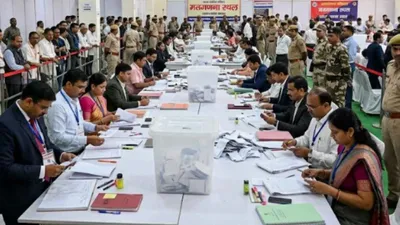
Uttar Pradesh MLC Election Results 2026: Power Dynamics, Counting Centers, and Road to 2027
The political battleground in Uttar Pradesh witnessed intense scrutiny as counting for 11 seats in the Uttar Pradesh Legislative Council (Vidhan Parishad) began on Tuesday, October 27, 2026, stretching into October 28. Comprising five Graduates’ and six Teachers’ constituencies, this biennial election serves as a crucial barometer of political sentiment among the state’s educated and professional demographics ahead of the high-stakes 2027 Uttar Pradesh Assembly elections.
With 152 candidates in the fray and a recorded voter turnout of 55.24% out of 14,81,310 registered voters, the contest has largely shaped into a direct, high-voltage clash between Chief Minister Yogi Adityanath’s ruling Bharatiya Janata Party (BJP) and Akhilesh Yadav’s Samajwadi Party (SP).
Live Status & Seat-Wise Outcomes
The BJP showed strong performance across traditional bastions, sweeping the state capital Lucknow’s teachers’ constituency and holding major northern seats. Concurrently, the Samajwadi Party made prominent inroads into eastern Uttar Pradesh and Agra, turning this election into a closely watched split mandate.
| Constituency | Winning / Leading Candidate | Party Affiliation | Key Takeaways & Margins |
| Meerut-Saharanpur Graduates’ | Dinesh Kumar Goyal (Declared) | BJP | Retained seat; defeated SP’s Pramod Singh Bhati by 12,855 votes. |
| Meerut Teachers’ | Shri Chand Sharma (Declared) | BJP | Retained seat; defeated SP’s Nitin Tomar by over 13,000 votes. |
| Lucknow Teachers’ | Umesh Dwivedi (Declared) | BJP | Retained seat; defeated SP’s Sushil Kumar Patel by 4,818 votes. |
| Bareilly-Moradabad Teachers’ | Hari Singh Dhillon (Declared) | BJP | Defeated SP’s Haji Mohammad Danish Akhtar. |
| Varanasi Teachers’ | Lal Bihari Yadav (Declared) | Samajwadi Party | Retained seat for SP in PM Narendra Modi’s parliamentary base. |
| Agra Teachers’ | Akash Agrawal (Declared) | Samajwadi Party | Won by SP candidate against BJP’s Hari Kishore Tiwari. |
| Gorakhpur-Faizabad Teachers’ | Dhruv Kumar Tripathi (Leading) | BJP | Narrow lead over Independent Rajiv Yadav and SP’s Sanjayan Tripathi. |
| Varanasi Graduates’ | Counting underway (SP Leading) | Samajwadi Party | SP maintaining a steady lead across multiple counting rounds. |
| Lucknow Graduates’ | Counting underway | Tightly Contested | Elimination rounds and preference transfers active. |
Designated Counting Centers and Security Measures
Given the multi-tier preference sorting and manual verification, counting centers were designated across seven key administrative hubs with multi-tier perimeter security and continuous CCTV surveillance:
- Lucknow: Ramabai Ambedkar Ground (Hall 7 designated for Graduates’ and Hall 8 for Teachers’ seats).
- Gorakhpur: Pandit Deendayal Upadhyay Gorakhpur University.
- Varanasi: Cultural Complex/Trade Facilitation Centre, Paharia.
- Meerut: Victoria Park sports complex counting pavilion.
- Agra: Mandi Parishad campus.
- Bareilly & Jhansi: District Mandi Samiti premises under direct district magistrate monitoring.
The geographical breadth of the election encompassed 72 of Uttar Pradesh’s 75 districts, establishing 2,697 polling stations.
How the Single Transferable Vote (STV) System Works
Unlike the First-Past-The-Post (FPTP) system applied in general Assembly or Lok Sabha elections, Legislative Council elections for Graduates’ and Teachers’ seats are conducted under the Proportional Representation by means of Single Transferable Vote (STV) using paper ballots.
                 +---------------------------------------------+
                 |       Ballot Paper First-Preference Count   |
                 +---------------------------------------------+
                                        |
                                        v
                 +---------------------------------------------+
                 |         Calculate Winning Quota             |
                 |      [Valid Votes / (Seats + 1)] + 1        |
                 +---------------------------------------------+
                                        |
                 +----------------------+----------------------+
                 |                                             |
        Quota Attained?                                 No Candidate Reaches
                 |                                             |
                 v                                             v
       Candidate Declared Elected               Lowest Candidate Eliminated
                 |                                             |
                 v                                             v
     Check for Remaining Seats                   2nd Preferences Transferred
                                                               |
                                                               v
                                                    Re-evaluate Against Quota
The Quota Formula
To win on the first count, a candidate must reach the Droop Quota threshold:
$$\text{Quota} = \left( \frac{\text{Total Valid Votes}}{\text{Number of Vacancies} + 1} \right) + 1$$
Because each constituency here represents a single vacancy, the required threshold is 50% of all valid votes plus one.
Why Counting Takes Over 24 Hours
If no candidate hits the quota in Round 1:
- The lowest-polling candidate is formally eliminated.
- The second preferences marked on their ballots are transferred to the continuing candidates.
- This process repeats through successive elimination rounds until a contender breaches the threshold or only one eligible candidate remains.
Because every ballot paper must be manually unsealed, bundled in sets of 50, verified for validity, and re-tallied per elimination cycle, results often take between 24 to 36 hours to formalize.
Council Polls vs. General Assembly Elections
The dynamics of Legislative Council elections differ markedly from state legislative assembly polls:
- Restricted Franchise: Assembly elections feature universal adult suffrage. Council seats for these 11 segments restrict voting exclusively to individuals who have held a graduate degree for at least three years (Graduates’ quota) or have spent at least three years teaching at secondary school grade levels and above (Teachers’ quota).
- Ballot Mechanics: While Assembly polls run on Electronic Voting Machines (EVMs), MLC elections utilize physical paper ballots marked with preference digits (1, 2, 3…).
- Campaign Focus: Instead of broad socio-economic rhetoric, Council campaigns hinge heavily on education policies, government teacher pensions (OPS restoration), higher education parity, service regularization, and urban professional grievances.
Political Significance Ahead of the 2027 UP Assembly Elections
While MLC seats represent a specific segment of the electorate, their political ramifications resonate well beyond the Legislative Council:
- Educated Urban Sentiment: Teachers and graduates represent opinion makers within civil society, government offices, and academic spheres. Retaining the capital city Lucknow and western industrial seats like Meerut confirms the BJP’s resilience within middle-class networks.
- SP’s Expansion Strategy: By clinching the Varanasi Teachers’ constituency and securing strong inroads into Agra and eastern UP segments, the Samajwadi Party demonstrates its ability to break the ruling party’s hold over institutional voter bases beyond its core rural or community-specific blocs.
- Psychological Advantage: With assembly elections due in early 2027, every electoral test serves as an organizational drill. The outcome provides strategic inputs for ticket selection, alliance positioning, and narrative framing over the next year.
Some References: